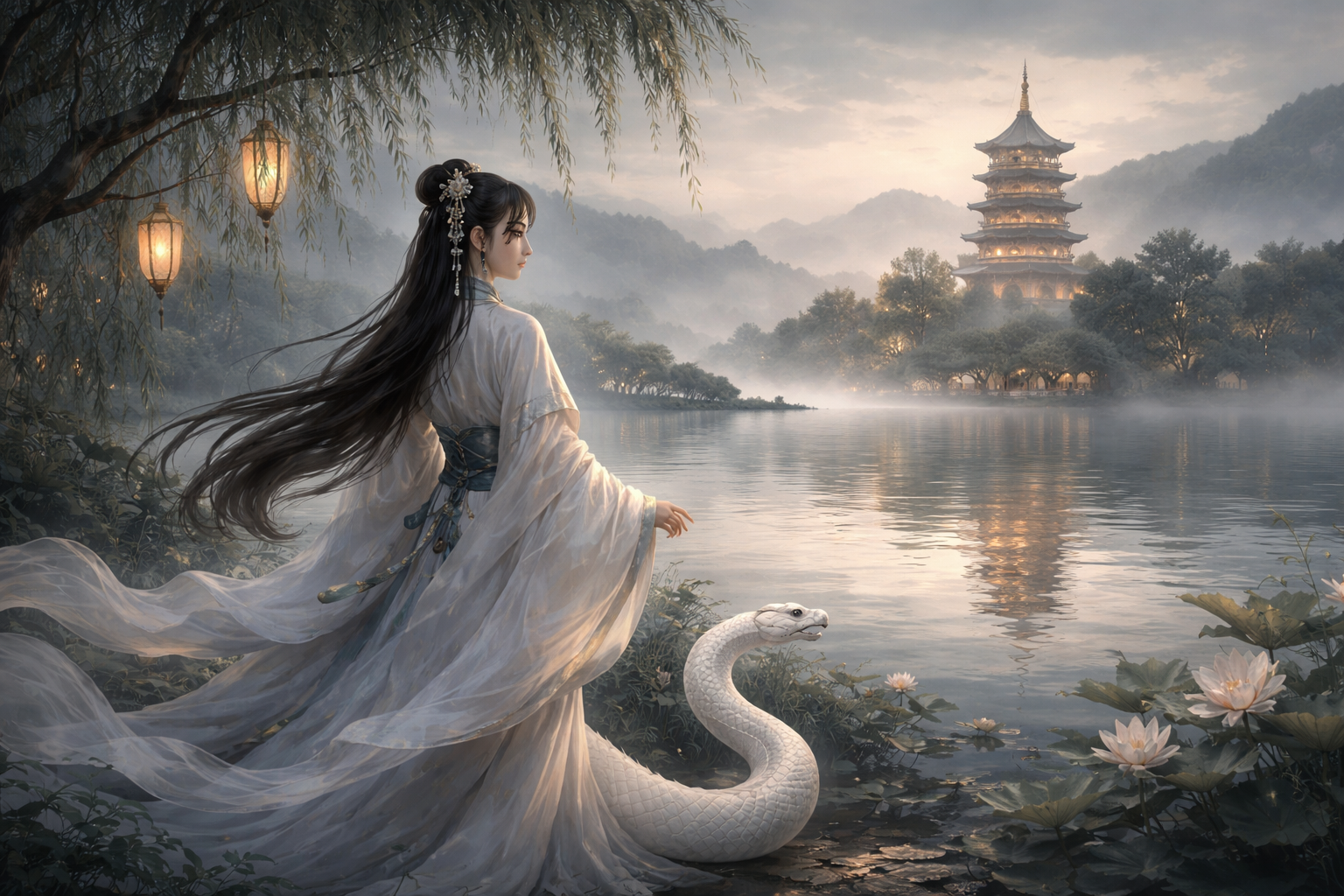
The Legend of the White Snake
Long before the world settled into neat borders between the ordinary and the divine, there were creatures who existed quietly between those lines. They listened. They learned. And sometimes, they wanted more than survival. Sometimes, they wanted a human life.
Bai Suzhen was one of them.
For a thousand years, she cultivated herself in places humans rarely noticed near rivers, beneath old trees, in caves where moonlight reached the stone floor only by accident. Time passed slowly there. Centuries were measured not in events but in patience. Over that long span, she learned discipline, restraint, and compassion. What she did not learn was how to stop wanting.
When she finally took human form, it was not power she was testing, but possibility.
She entered the human world during the Qingming Festival, when families honored the dead and rain softened the edges of everything. On the Broken Bridge in Hangzhou, umbrellas bumped and strangers passed without looking twice at one another. That was where she met Xu Xian.
He was an herbalist, unremarkable in every way that matters to history and invaluable in every way that matters to life. When he offered her his umbrella, it was without suspicion or expectation. It was a small kindness, the kind that usually disappears as soon as it’s given. For Bai Suzhen, it lingered.
They met again. Then again after that. Conversation replaced coincidence. Familiarity replaced caution. Bai Suzhen felt the strange weight of it the danger of being seen and the comfort of being known. Loving a human meant accepting limits she had never lived with before. It meant illness, aging, and loss. She chose it anyway.
They married quietly.
Their life together was simple. They ran a small medicine shop, treated the sick, and earned a reputation for kindness rather than wealth. Bai Suzhen healed people carefully, blending what she had learned over centuries with the knowledge of human remedies. For a while, it worked. She was respected. She was loved. The world did not punish her for being different.
That peace attracted attention.
Fa Hai, a Buddhist monk, sensed what others could not. To him, the presence of a spirit among humans was not a miracle or a romance it was a disruption. Order mattered more than happiness. Boundaries mattered more than intention. Bai Suzhen’s compassion did not change what she was.
He warned Xu Xian. At first, Xu Xian resisted. Love makes disbelief easy. But doubt is patient. During the Dragon Boat Festival, Fa Hai gave Xu Xian realgar wine and told him to offer it to his wife. The wine was lethal to snakes. Xu Xian hesitated, then obeyed.
Bai Suzhen drank it to preserve her secret.
The transformation was violent and immediate. Her human form collapsed, revealing the white serpent beneath. Xu Xian returned home and saw what fear had prepared him to see. His heart failed him. He died where he stood.
Bai Suzhen did not grieve the way humans do. She moved. She crossed forbidden boundaries and risked spiritual annihilation to retrieve a sacred herb from Mount Kunlun. It was an act that damaged her cultivation permanently, but it worked. Xu Xian lived.
What could not be repaired was the balance she had tried to maintain.
Fa Hai took Xu Xian and confined him at Leifeng Pagoda, claiming it was for his protection. Bai Suzhen confronted the monk despite being weakened and pregnant. When reason failed, she summoned the river itself, flooding the temple grounds in a final attempt to reclaim her husband. The waters rose, but heaven did not answer. Because she carried a human child, her power faltered.
She lost.
Fa Hai sealed her beneath Leifeng Pagoda and told the world it was an act of mercy. From the outside, the structure looked calm and orderly, a place people visited to light incense and feel reassured that the world still made sense. No one asked what it was like beneath the stone floor.
Down there, time became difficult to measure. Days blurred. The air was always cool. Bai Suzhen could hear footsteps above her and the low hum of chanting, but the sounds never reached her clearly. Sometimes she counted seasons by the way the pressure in her chest changed, by the faint shift in the air. She did not sleep much. She remembered instead Xu Xian’s hands, their shop, the ordinary happiness she had once believed might last.
Xiao Qing tried to free her almost immediately.
The attempt failed. Fa Hai was stronger than she expected, and defeat came quickly. Wounded and outmatched, Xiao Qing was driven into exile. But she did not forget. Anger followed her wherever she went. So did guilt. Over time, both hardened into resolve. She stopped believing in harmony and focused on endurance.
Above the pagoda, the world continued without ceremony. Dynasties rose and fell. Xu Xian aged, carrying grief with quiet persistence. He became a monk, not out of enlightenment, but because it was the only way he knew to remain close to Bai Suzhen. Each day, he prayed facing the pagoda, knowing she could not answer.
Their son grew up knowing his mother only through stories. He studied, succeeded, and honored her publicly when the time came. It was not defiance only truth. Still, it mattered. The heavens, silent for a long time, took notice.
When Xiao Qing returned, centuries had passed.
She was no longer reckless. What she carried now was restraint sharpened by patience. Whether it was divine mercy, accumulated devotion, or a debt that could no longer be ignored, the result was the same. Leifeng Pagoda cracked and collapsed.
Bai Suzhen stepped back into daylight without triumph or apology. Only the end of waiting.
The legend endures not because it warns against crossing boundaries, but because it questions who gets to enforce them. Bai Suzhen did not seek to challenge the world. She only wanted to live honestly within it. And for that, she paid everything.