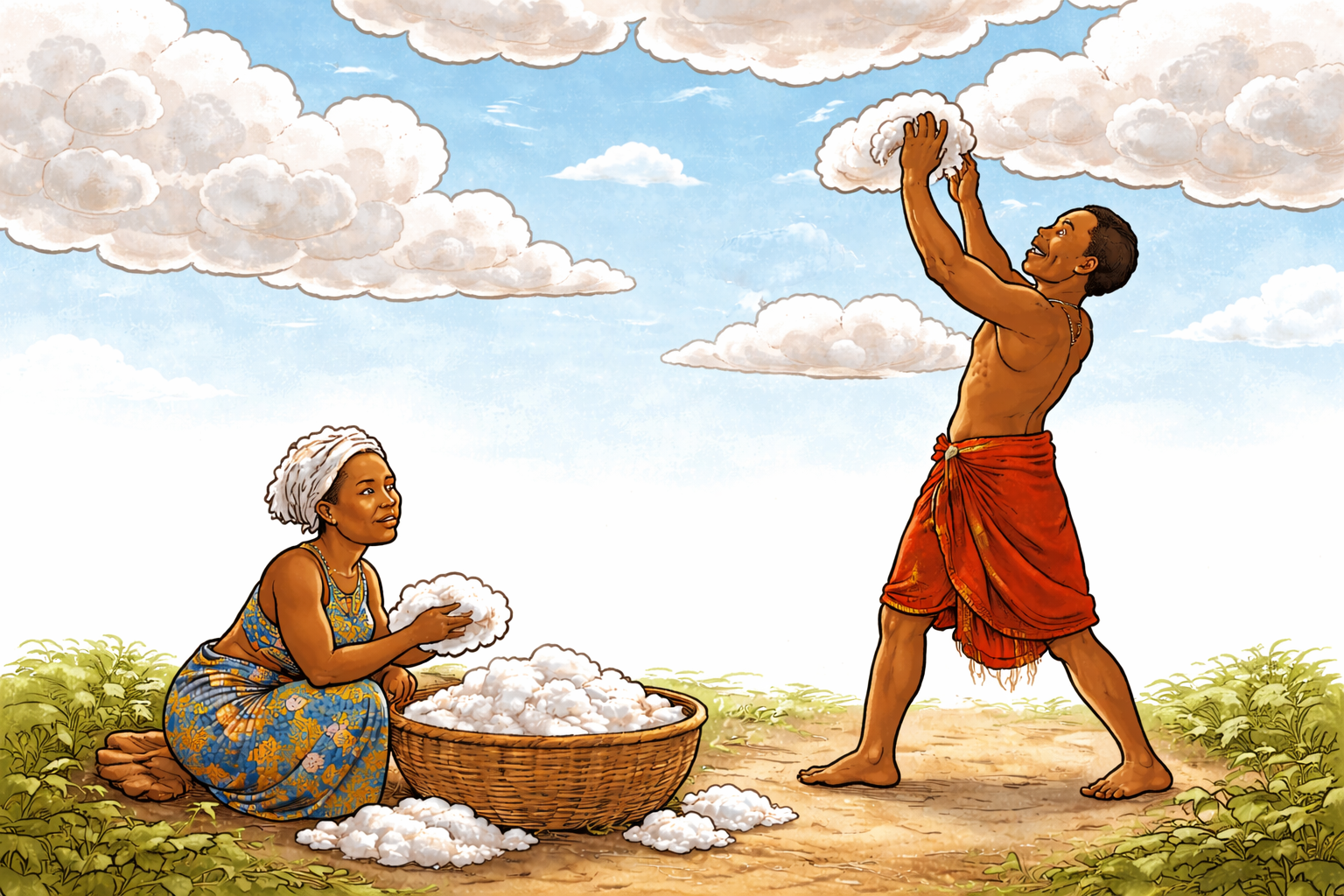
Why the Sky Is Far Away
People say there was a time when the sky did not live so far above us.
Not like now, where you have to crane your neck to see it and even then it feels distant, like something that belongs to birds and clouds and prayers. Back then, the sky was close. Close enough that you could feel it above you, like a low roof or a ceiling that had been built without much thought for space.
According to an old Nigerian folktale, this was how the world once was.
In those days, people did not farm. They did not plant or wait or worry much about food. Hunger was not something that stayed with you. When someone felt hungry, they simply raised their hands and tore off a piece of the sky. The sky itself was food. You ate it, and you were full.
No fire. No tools. No preparation.
At first, people were careful. They took small pieces and ate everything they pulled down. There was no reason not to. The sky stayed where it was, quiet and giving, and no one questioned how long it would last. Why would they? It had always been there.
Over time, though, people got used to it.
What is always there starts to feel ordinary. People began tearing off larger pieces than they needed. Sometimes they took more than they could eat and threw the rest away. Sometimes they reached up out of boredom, not hunger. Children pulled at the sky while playing. Adults did not stop them.
Pieces of the sky started to fall to the ground.
At first, no one thought much about it. There was always more. If food is endless, waste does not feel like a problem. People stepped over discarded pieces without noticing. Some were trampled into the dirt. Some were left to rot.
The sky saw all of this.
In many Nigerian stories, the sky is not just a place. It is aware. It watches what people do and remembers it. The sky had given itself freely so that people could live, not so that they could be careless.
Still, it waited.
It did not move right away. It stayed low, as it always had, perhaps hoping people would change on their own. But nothing changed. If anything, the waste grew worse. People took without thinking and threw away without regret.
Then, one day, the sky began to rise.
Not suddenly. Not all at once. Just a little higher than before.
The first people to notice laughed. They reached up and missed. They stretched higher, surprised, and joked about it. Some jumped and managed to tear off a small piece. Others could not.
The next day, the sky was higher again.
Now people were confused. They stood on their toes. They piled stones. They reached as far as they could, but the sky kept pulling away. Each time they tried, it seemed farther than before.
Panic followed.
People realized they were truly hungry for the first time. Not the kind of hunger that passes quickly, but the kind that stays in your body. They cried out to the sky. They apologized. They promised to stop wasting it. They promised to take only what they needed.
But the sky did not come back down.
It had already decided.
From that day on, the sky stayed far above the earth, out of reach. People could see it, but they could not touch it anymore. The easy days were over.
With no sky to eat, people had to learn how to survive in a different way. They looked at the ground for the first time and wondered what it could offer. They dug into the soil. They planted seeds without knowing if anything would grow. Sometimes the crops failed. Sometimes they succeeded.
They learned patience by force.
Food became something you worked for. Something you planned for. Hunger became something you remembered and feared. People learned to share, because they knew what it was like to have nothing.
The sky still helped, but only from a distance. It sent rain. It gave light. But it no longer allowed itself to be taken apart and wasted.
That distance, the story says, is not an accident.
When elders tell this story, they do not say the sky moved away because people were hungry. Hunger was never the problem. The problem was carelessness. The problem was forgetting that what is given can also be taken back.
Even now, when people look up and see how far away the sky is, the story explains why it stays there. It is not punishment exactly. It is a reminder.
The sky is far away because once, it was close and people did not treat it well.