Before the Name Became a Card
Rome liked men to be useful.
Useful men marched when told, fought when ordered, and died without leaving too much behind. Useful men did not hesitate. They did not look back. They did not build lives that might compete with the needs of the state.
That was the logic behind the edict, at least. Emperor Claudius II did not wake up one morning hating love. He was fighting wars on too many fronts with soldiers who deserted, hesitated, or broke ranks when letters from home arrived. Wives made men slower. Children made them human. And humanity was inefficient.
So marriage was restricted for young men of fighting age.
It was announced plainly, without apology. Laws in Rome were not meant to be understood emotionally. They were meant to be obeyed.
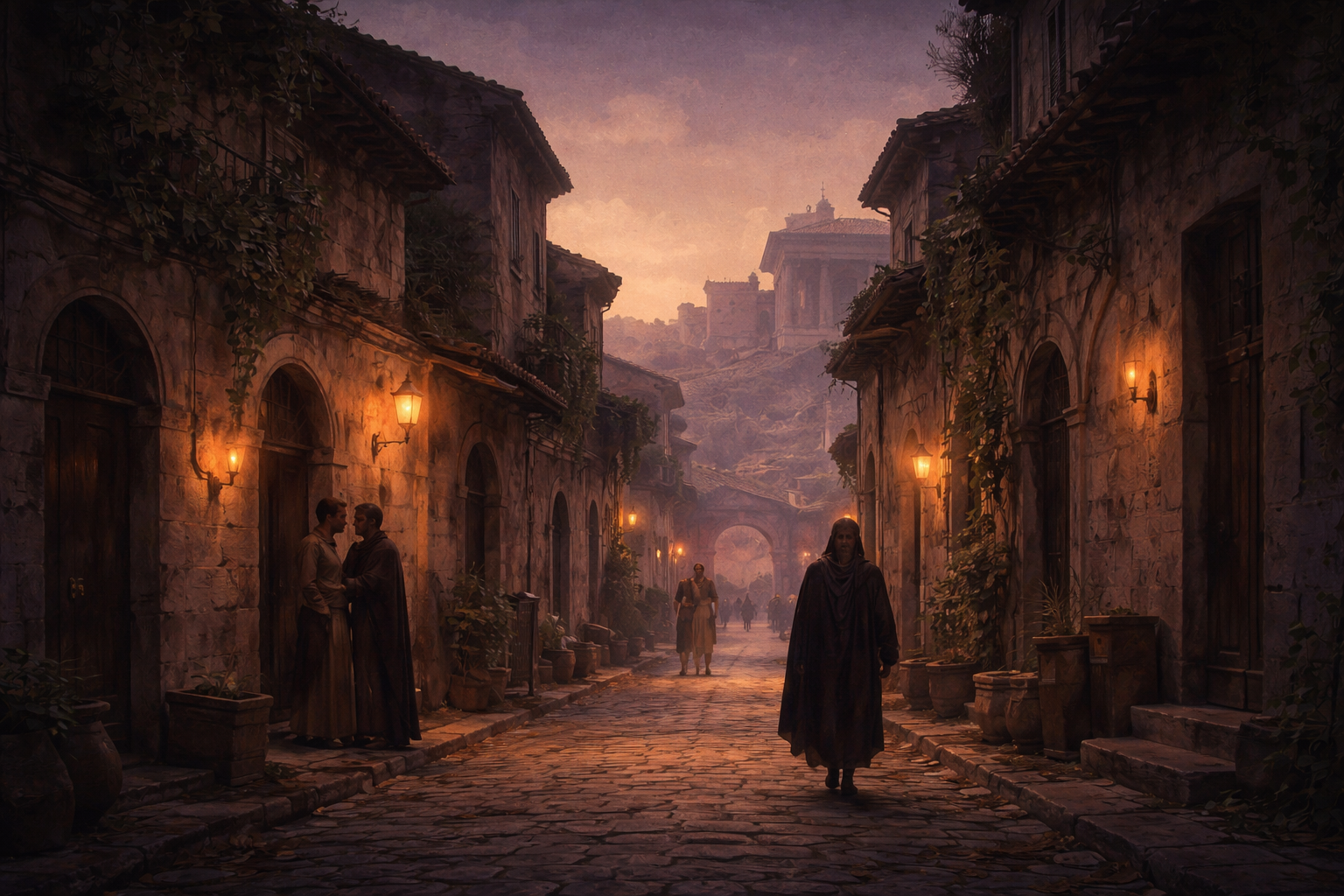
Valentinus heard the decree in the forum like everyone else. He stood among tradesmen and soldiers and tried not to read the faces around him. The empire trained people to survive by appearing unaffected.
Valentinus was not important. He did not advise governors or challenge senators. He was a priest on the margins of a city that had learned to tolerate Christians only when they stayed quiet. He baptized infants whose names he would forget. He buried bodies whose families could not afford stones.
He believed marriage mattered, but not because it was romantic.
It mattered because it made people accountable to one another. Because it gave structure to grief. Because it turned death from a statistic into a loss.
When couples began coming to him, he did not feel righteous. He felt afraid.
They came separately, never together at first. A woman would arrive pretending to need counsel. A man would follow days later, speaking too quickly, eyes always moving. Valentinus would listen, nod, stall, and hope they would change their minds.
They never did.
So he married them quietly. No hymns. No witnesses beyond the walls. Just vows spoken in voices already shaped by fear. Soldiers left the same night. Some never returned.
Valentinus told himself each ceremony would be the last. He told himself that the state could not afford to notice someone as small as him.
Rome noticed everything eventually.
The arrest was efficient. No violence. No speech. Just hands on his arms and the dull certainty that something had ended.
Prison was not dramatic. It was monotonous. Days stacked on top of each other until time lost texture. Valentinus learned how much of life was noise you didn’t miss until it was gone footsteps, doors, voices arguing about nothing.
The jailer was a practical man. He did his job and avoided unnecessary cruelty. His daughter, Julia, visited often. She sat near the cell and read aloud because reading silently felt pointless when sight had already been taken from her.
She asked Valentinus questions the way people do when they are not sure what they are allowed to ask.
Why would someone break a law knowing it would end badly?
Did God care about intention if the outcome was suffering?
Was love always supposed to cost something?
Valentinus did not answer carefully. He had stopped trying to sound certain.
He told her he didn’t know if he had done the right thing. He told her that some nights he wondered if obedience would have saved more people than defiance. He told her that courage often looked like stubbornness when viewed from the outside.
Julia listened without interrupting. That alone felt radical.
Later centuries would claim he healed her blindness. History cannot verify that. What is verifiable is quieter: people who are treated as fully human often stand differently in the world afterward. Julia did.
As Valentinus’s execution approached, something unexpected happened. Fear faded. Not because he was brave, but because the choices were finished. The uncertainty was gone.
The night before his death, he asked for paper. The request was not unusual. People at the end often wanted to explain themselves. The jailer hesitated, then agreed.
Valentinus did not write a defense. He did not curse the emperor. He wrote to Julia because she had heard him when no one else needed to.
He wrote about small things. About how her questions had mattered. About how being listened to had reminded him that his life had not been reduced entirely to a crime.
He signed the letter simply:
From your Valentine.
It was not a phrase meant to echo. It was a closing, nothing more.
The execution happened outside the city walls. No crowd. No ritual beyond procedure. Valentinus died the way most dissidents do quietly, efficiently, without witnesses who would matter to power.
Rome continued.
What happened next did not belong to him anymore.
Over time, the story changed. The priest became a martyr. The martyr absorbed romance. February, once a month of endurance, became associated with pairing and renewal. Birds mating were noticed. Poets embroidered. The violence was softened until it could be consumed without discomfort.
By the Middle Ages, Valentinus had become something else entirely: a symbol, a name invoked for affection rather than resistance.
But underneath the transformation remains an inconvenient truth.
The origin of Valentine’s Day is not sweetness.
It is not flowers.
It is not even romance.
It is a conflict between human attachment and institutional control.
A state tried to limit love because love complicated obedience.
A man refused to treat people as tools.
And that refusal small, unremarkable, deeply human outlasted the law meant to erase it.
Valentinus did not win. He did not live. He did not change Rome.
But centuries later, people still write his name on letters meant to remind someone they are chosen.
That was never his intention.
It is simply what happens when power tries to regulate the most human thing people do and fails, slowly, over time.