The Green Shadow of Sherwood
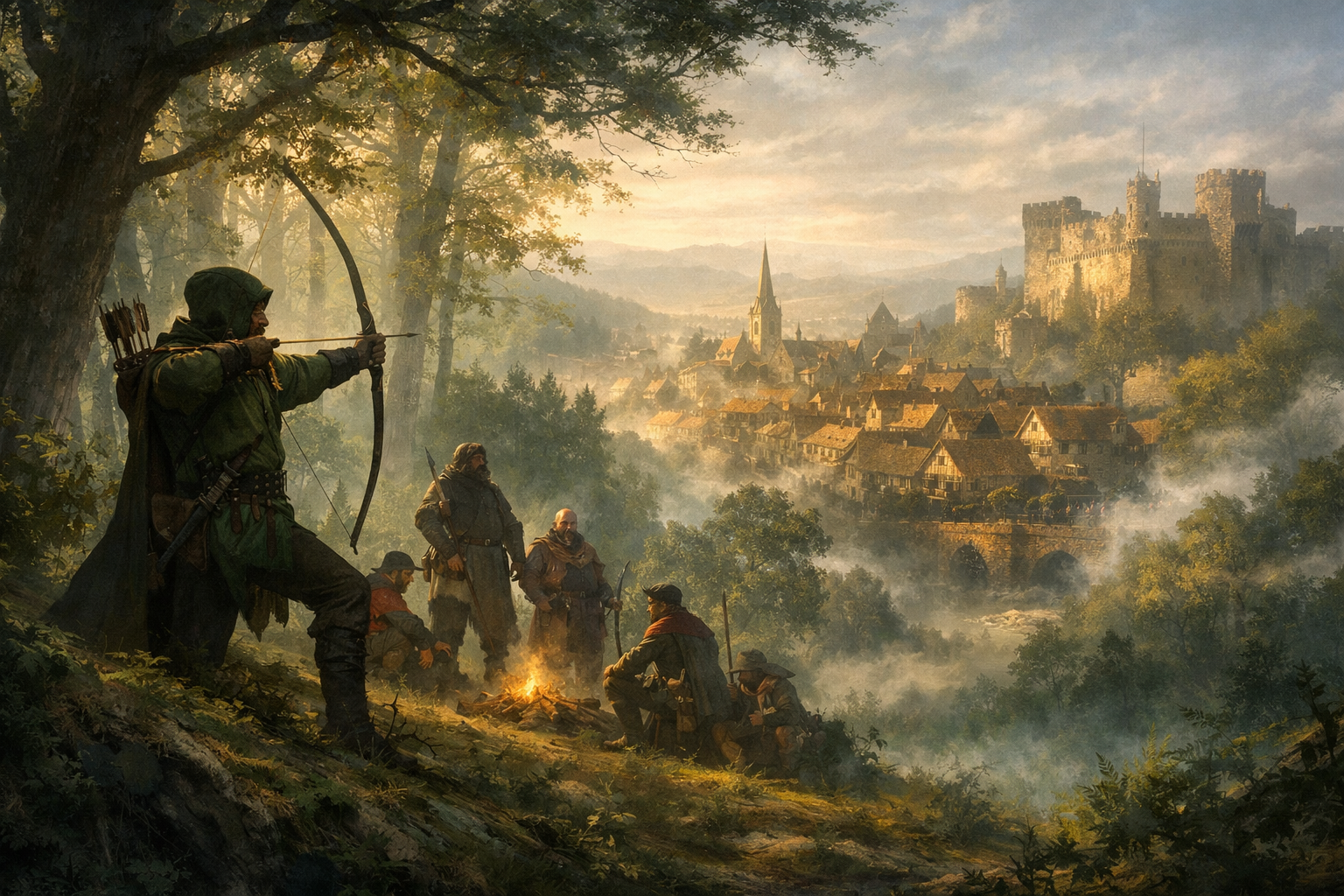
In the oldest part of Sherwood Forest, where the oaks stood so wide that three men together could not encircle them, there was a stillness that did not feel empty. It felt watchful.
The forest had memory.
It remembered kings hunting beneath its branches. It remembered wolves. It remembered hunger winters and peasant revolts. And now it remembered a man in green who walked without fear beneath its canopy.
Robin Hood did not think of himself as a legend.
He thought of himself as a man who had seen too much.
In the town of Nottingham, the market bells rang each morning with forced cheer. Bakers laid out loaves smaller than the year before. Butchers stretched thin cuts of meat across too many hooks. Tax collectors moved through the crowd like shadows with ledgers.
Above them all ruled the Sheriff of Nottingham a man who wore polished armor even when no battle threatened. His power did not come from swords. It came from signatures, seals, and soldiers who obeyed without question.
That year, the rains had failed.
Crops thinned.
Taxes did not.
Robin first drew blood not with an arrow but with a decision.
He had once worked the land himself. He knew what it meant to watch seedlings fail. He knew the humiliation of handing over coin scraped together from nothing. When he saw an old farmer dragged into the square for unpaid levies, something inside him hardened.
The farmer’s crime? Keeping enough grain for winter.
Robin stood in the crowd that day, hood low, jaw clenched. When the Sheriff’s men overturned the farmer’s cart and confiscated the sacks, the people did nothing. They had learned survival through silence.
Robin had not.
That night, beneath a sky cold with stars, a tax wagon left Nottingham for the castle treasury.
It did not arrive.
The ambush was swift, almost gentle.
A single arrow cut the reins of the lead horse. Another pinned a guard’s sleeve to a tree without touching flesh. The message was precise: we could kill you. We choose not to.
When the guards fled, they left behind three chests of coin and grain.
Robin did not keep the spoils. By dawn, sacks of flour sat on doorsteps across the poorest quarter of Nottingham. No note. No name.
But people knew.
They always know when hope moves through the night.
The forest began to gather men.
The first was Little John though there was nothing little about him. They met on a narrow bridge crossing a stream swollen from spring rain. Neither would step aside.
They fought with quarterstaves until both were breathless and laughing.
“Then we are evenly matched,” John said.
“No,” Robin replied, grinning. “We are evenly stubborn.”
John joined him that day.
Others followed. Will Scarlet, hot-blooded and sharp-eyed. Much the Miller’s Son, eager and reckless. And Friar Tuck, who claimed he joined only to keep the others from sin but swung a staff with suspicious enthusiasm.
They built no fortress. Their home was woven from branches and hidden paths. Fires were kept low. Watches were constant.
But there was laughter.
That was what frightened authority most.
Not arrows.
Laughter.
Word spread beyond Sherwood. Ballads began in alehouses half-true, half-invented. Some said Robin was of noble birth, dispossessed by betrayal. Others swore he was a simple yeoman with uncommon aim.
Robin never corrected them.
The truth mattered less than the work.
Yet even in rebellion, doubt crept in.
One evening, as they divided stolen coin among families who had lost land, a young boy approached Robin.
“Are you a thief?” the boy asked plainly.
Robin paused.
“Yes,” he said. “But not the kind who sleeps well on silk.”
The boy studied him, then nodded as if satisfied.
It was the closest thing to absolution Robin would ever receive.
The Sheriff’s patience thinned.
Rewards doubled.
Then tripled.
Gallers were reinforced. Informants were promised pardons.
Finally, the Sheriff announced an archery tournament in Nottingham winner to receive a golden arrow crafted by the finest smith in England.
It was bait.
Everyone knew it.
Robin smiled when he heard.
“You cannot resist,” Little John warned.
“I don’t intend to,” Robin replied.
Disguised in worn cloth and false beard, he entered the town he had once walked freely. The square brimmed with spectators. Guards lined the edges like iron teeth.
Archers stepped forward one by one.
Arrows thudded into targets.
Close.
Closer.
Then the stranger in faded green stepped to the line.
He drew the longbow slowly not with flourish, but with familiarity. The world narrowed to wood, string, breath.
Release.
The arrow split the center shaft clean in two.
For a heartbeat, silence ruled the square.
Then recognition.
“Seize him!” the Sheriff roared.
Chaos erupted. Hidden among merchants and peasants, the Merry Men moved like sparks through dry grass. Smoke bombs burst. Carts overturned. Horses reared.
Robin reached the platform where the golden arrow gleamed.
He held it only long enough to feel its weight.
Then he handed it to a widow clutching two children near the scaffold.
“For your winter,” he said.
And he vanished into the forest as soldiers chased shadows.
Winter did come.
Hard and white.
There were nights when even Robin questioned the cost. Men were captured. One did not return. The Sheriff tightened control over Nottingham, punishing villages suspected of sympathy.
Robin watched smoke rise from a distant farm and felt something dangerously close to guilt.
Was he helping?
Or only provoking?
That night, villagers arrived quietly at the forest’s edge.
They brought bread.
Blankets.
Information.
“You give us courage,” an old woman said. “Courage feeds more than coin.”
Robin understood then: resistance was not about victory.
It was about refusal.
Refusal to accept cruelty as normal.
Refusal to bow when standing was still possible.
Years blurred.
Some say Robin was eventually betrayed. Some say he was wounded and sought refuge in a convent where treachery found him. Others claim he escaped across the sea.
History does not agree.
But history rarely keeps what matters most.
What endured was the idea.
A man without crown or title who challenged corruption.
A thief who stole imbalance and returned dignity.
In every age where power hoards and hunger spreads, his name surfaces again.
Not because he was perfect.
But because he was human.
And humans, when pushed far enough, learn to draw their own bows.