The Loch Ness Monster: Scotland’s Living Question Mark
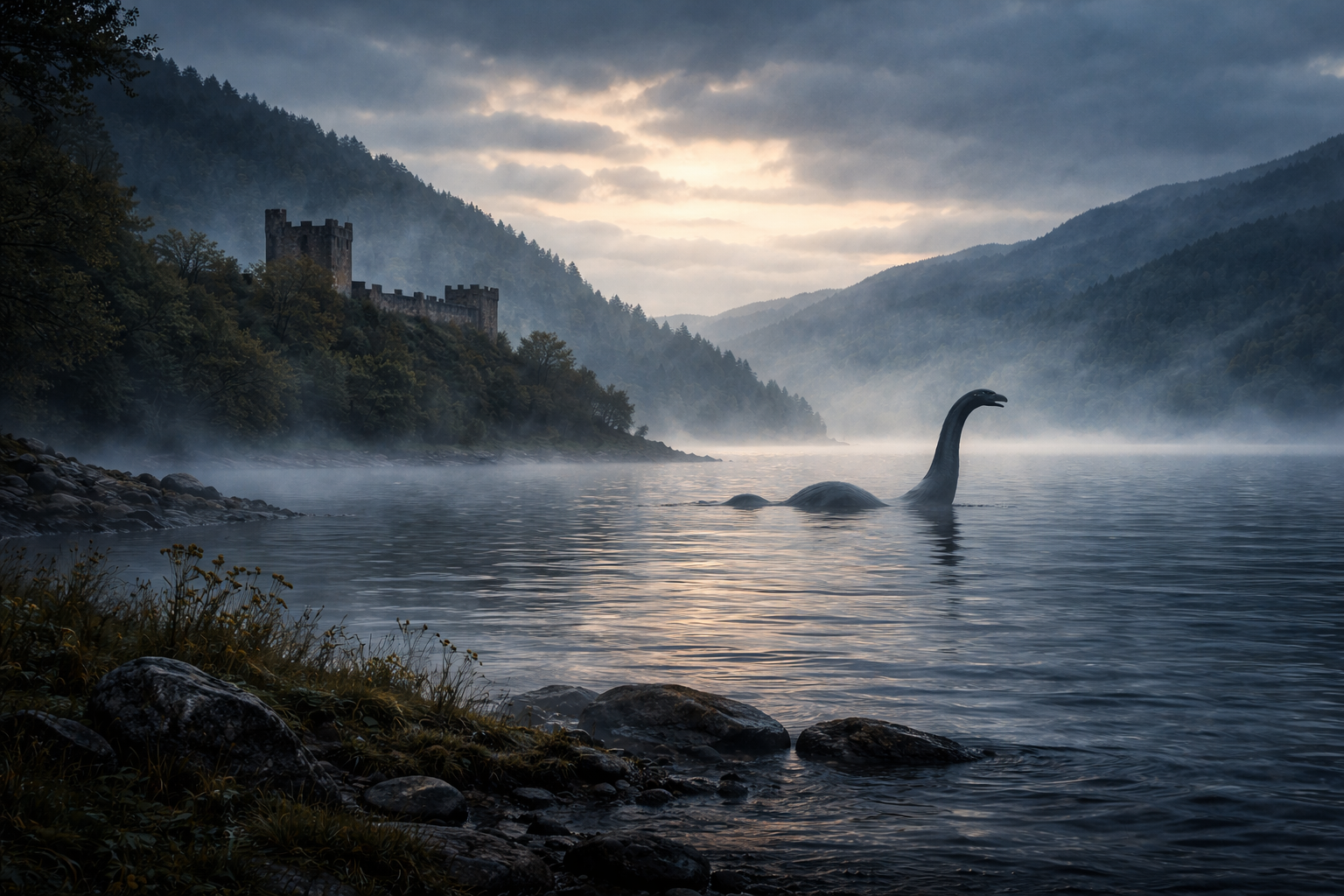
Stand on the edge of Loch Ness on a grey morning and you’ll understand something immediately: if a monster were going to live anywhere, it could live here.
The water is dark not blue, not green, but almost black when the clouds hang low. The loch stretches for miles through the Scottish Highlands, deep and cold and quiet in a way that feels deliberate. Even when there are boats out, the surface swallows sound. You find yourself scanning it without meaning to.
Locals call the creature “Nessie,” which softens it. Makes it familiar. Almost affectionate.
But the story itself is not soft.
A Lake That Hides Things Well
Loch Ness is one of the largest freshwater bodies in the United Kingdom by volume. It is over 700 feet deep in places, carved by glaciers and fed by rivers that carry peat from the surrounding hills. That peat stains the water a murky brown-black, reducing visibility to almost nothing below the surface.
In other words, it is perfect for mystery.
The city of Inverness sits at the northern end of the loch, and nearby ruins like Urquhart Castle watch over the water as if they, too, are waiting for something to surface.
The setting does half the storytelling on its own.
Older Than the Headlines
Although Nessie became a global sensation in the 20th century, the idea of a strange creature in the loch reaches further back.
One of the earliest references appears in a 7th-century account of Saint Columba, who reportedly encountered a “water beast” in the River Ness. The story is brief and symbolic, but it plants the seed: something lives in these waters.
For centuries after, the loch was simply a loch fished, crossed, respected. The modern legend as we know it truly began in 1933, when a road was completed along the shoreline, offering clearer views of the water than ever before. That year, several people reported seeing a large creature rolling or surfacing.
Newspapers ran with it.
Once the idea was public, sightings multiplied.
The Photograph That Changed Everything
In 1934, an image now known as the “Surgeon’s Photograph” appeared in the press. It showed what looked like a long neck rising from the water, small head tilted slightly forward.
For decades, that image defined Nessie.
It was grainy. Distant. Convincing enough.
Tourists arrived. Investigators set up cameras. Boats dragged sonar equipment through the depths. The loch became not just a body of water, but a stage.
Years later, the photograph was revealed to be a hoax a small model attached to a toy submarine.
But by then, it didn’t matter.
The story had taken on a life of its own.
What People Think They See
Descriptions of the Loch Ness Monster vary, but certain details repeat. A long neck. A small head. One or more humps breaking the surface. A creature that moves smoothly, almost deliberately, before slipping under again.
Some link Nessie to prehistoric reptiles particularly the plesiosaur, a marine reptile from the age of dinosaurs. The resemblance is obvious enough to spark the theory.
Scientists are quick to point out the problems with this idea. Loch Ness formed at the end of the last Ice Age. It is landlocked. The ecosystem would struggle to support a breeding population of large reptiles unnoticed.
And yet.
The human mind resists clean endings.
Because what people describe isn’t always a dinosaur. Sometimes it’s a disturbance. A shape where there shouldn’t be one. A ripple that doesn’t behave like wind.
In a place where visibility is limited and imagination fills gaps easily, certainty becomes slippery.
A Modern Folktale
Unlike ancient mythological creatures tied to gods or moral lessons, Nessie belongs to a different category.
She is not sacred.
She does not punish or reward.
She simply might be there.
That’s what makes the Loch Ness Monster fascinating. It is a secular mystery a story born in an age of photography, newspapers, and scientific skepticism. And still it thrives.
People do not travel to Loch Ness expecting a revelation from heaven. They come hoping to glimpse something unexplained in the natural world.
It’s less about belief and more about possibility.
Tourism, Identity, and Playfulness
The Highlands have embraced Nessie with humor and pride. Souvenir shops sell plush monsters. Boat tours advertise “Nessie hunts.” Museums display sonar scans and historical reports.
It would be easy to dismiss this as pure commercialization, but that misses something.
Regional folklore often becomes a way for communities to shape their own narrative. Nessie gives Loch Ness an identity beyond geography. It turns a stretch of water into a destination.
And there’s affection in it.
Locals will debate sightings with a smile. Some say they believe. Others say they enjoy that people want to believe.
In either case, Nessie has become part of the landscape.
The Psychology of the Deep
There’s something else at work here.
Large bodies of dark water unsettle people. Depth represents the unknown in a very literal way. We evolved to read surfaces forests, plains, skies. Deep water hides everything beneath it.
The Loch Ness Monster functions as a placeholder for that hidden world.
It gives shape to uncertainty.
Instead of “there might be anything down there,” the mind settles on “there might be this.”
And “this” becomes a long neck cutting through mist.
The Endless Investigation
Over the decades, Loch Ness has been scanned with sonar, photographed from satellites, surveyed with underwater cameras and even environmental DNA sampling to detect unusual species.
Nothing definitive has emerged.
And still, sightings continue.
Some are almost certainly misidentified logs, waves, birds, or boat wakes. Others are harder to explain but no less inconclusive.
The mystery survives not because of proof, but because of its absence.
Why Nessie Endures
In an era where satellites map the globe and deep-sea drones explore ocean trenches, it’s comforting maybe even necessary to believe that something might still be out there.
The Loch Ness Monster does not threaten cities. It does not demand sacrifice. It simply exists as a question mark in cold water.
A reminder that not every corner of the natural world has been fully translated into data.
And perhaps more importantly, a reminder that humans still want to be surprised.
Stand at the edge of Loch Ness at dusk. Watch the wind ripple across the surface. Wait long enough and you’ll start to see patterns in the dark.
Whether those patterns are waves or something else depends partly on the water and partly on you.
That space between certainty and imagination is where Nessie lives.
And as long as the loch remains deep and the sky remains grey, she probably always will.