The Wendigo: When Hunger Stops Being Human
Winter in the north is not poetic.
It is long. It is loud at night. Trees crack when the temperature drops fast enough. Breath turns sharp in your throat. Food matters in a way people in warmer climates rarely have to think about.
For Algonquian-speaking peoples such as the Ojibwe, the Cree, and the Algonquin, winter was not just a season it was a test. Communities stored what they could. They hunted carefully. They relied on one another.
And still, sometimes, it wasn’t enough.
Out of that reality comes the Wendigo.
Not a campfire monster meant to entertain children. Not originally. The Wendigo is what happens when hunger turns into something else.
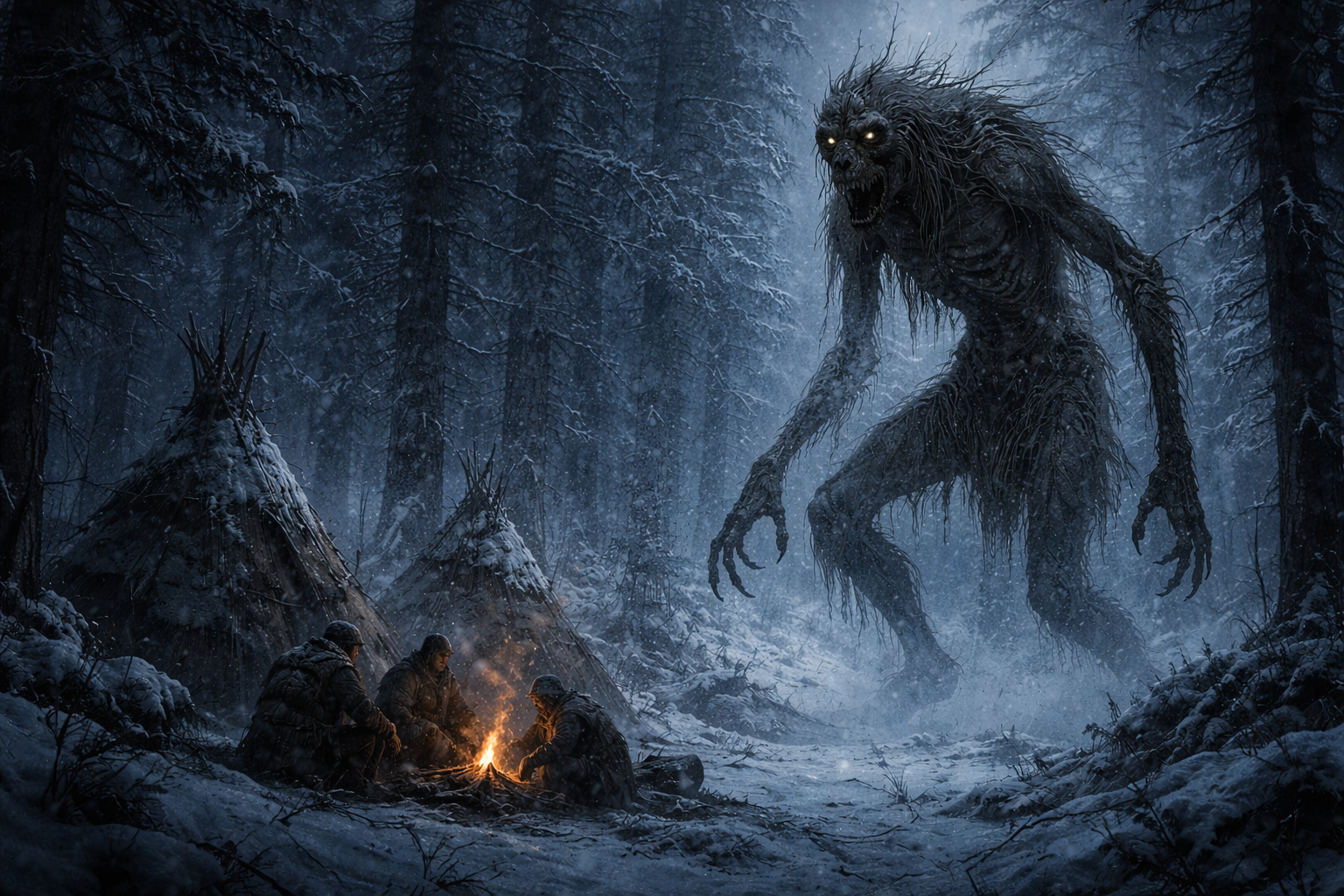
The descriptions vary depending on the region and storyteller. Sometimes the Wendigo is enormous, moving fast across snow, impossible to outrun. Sometimes it is thin and almost fragile-looking ribs showing, skin drawn tight, eyes sunk deep in a skull-like face.
But there is one detail that stays consistent.
It is always starving.
It eats, but it does not fill.
That detail feels important. It tells you what the story is really about.
In extreme winters, famine was real. Isolation was real. And in those conditions, people could be pushed toward decisions that would normally be unthinkable.
The Wendigo legend sets a hard boundary around one of those decisions: cannibalism.
In many tellings, a person who eats human flesh does not simply commit a taboo they change. The change may begin slowly. They withdraw. They become obsessed with thoughts of hunger. They speak differently. Act differently. The appetite grows even as the body wastes away.
Eventually, they are no longer considered fully human.
The story doesn’t pretend desperation doesn’t exist. It acknowledges it. But it refuses to excuse it.
That refusal is the point.
When survival depends on trust when your life depends on the people beside you some lines cannot be crossed without breaking the entire structure of the community.
The Wendigo is what stands on the other side of that line.
Over time, the figure came to represent more than famine.
Greed, too, can create a Wendigo.
Someone who hoards food while others go hungry. Someone who takes more than they need. Someone who cannot stop consuming whether what they consume is meat, land, power, or wealth.
In some versions, the Wendigo’s heart is made of ice.
That image is not subtle. It doesn’t need to be.
Cold is not evil in northern cultures. Cold is normal. But a frozen heart that’s different. That’s a refusal of warmth, of reciprocity, of shared survival.
The Wendigo is appetite without relationship.
European traders and missionaries later wrote about cases of people who believed they were becoming Wendigos or feared they might attack others during times of stress or starvation. Those accounts were filtered through outside interpretations, sometimes exaggerated, sometimes misunderstood.
What’s more important is this: the fear of becoming a Wendigo was real inside the communities that told the stories.
That fear worked as a safeguard.
If someone began speaking obsessively about hunger, or acting in ways that frightened others, the community responded. There were rituals meant to heal. Spiritual leaders who intervened. The goal was not spectacle. It was protection.
Because once trust collapses in a winter camp, survival collapses with it.
Modern pop culture often turns the Wendigo into something else entirely antlers, animal skulls, exaggerated claws. A forest demon stitched together from horror imagery.
But in many earlier Algonquian tellings, the most unsettling thing about the Wendigo is how human it looks.
Not a beast.
A person stretched thin by starvation and hollowed out by obsession.
That closeness makes the story harder to dismiss. The danger isn’t some distant creature lurking in the woods.
It’s what a human being might become under pressure.
There is a reason this story still circulates.
Not because winters are the same now. Not because famine defines daily life in the same way. But because insatiable hunger still exists just in different forms.
Endless consumption. Endless extraction. Endless taking.
The Wendigo is a warning about imbalance. About what happens when desire grows larger than responsibility.
It reminds people that survival is not just physical. It is moral. It is communal.
And in the old forests, when wind moves across frozen lakes and the nights stretch long, the lesson is simple and unsentimental:
Hunger is natural.
Becoming hunger is not.