Hitobashira and the Woman Beneath the Castle
A story people still remember when the rain will not stop
Long before Maruoka Castle became a quiet landmark visited by tourists, it was a place of frustration and fear.
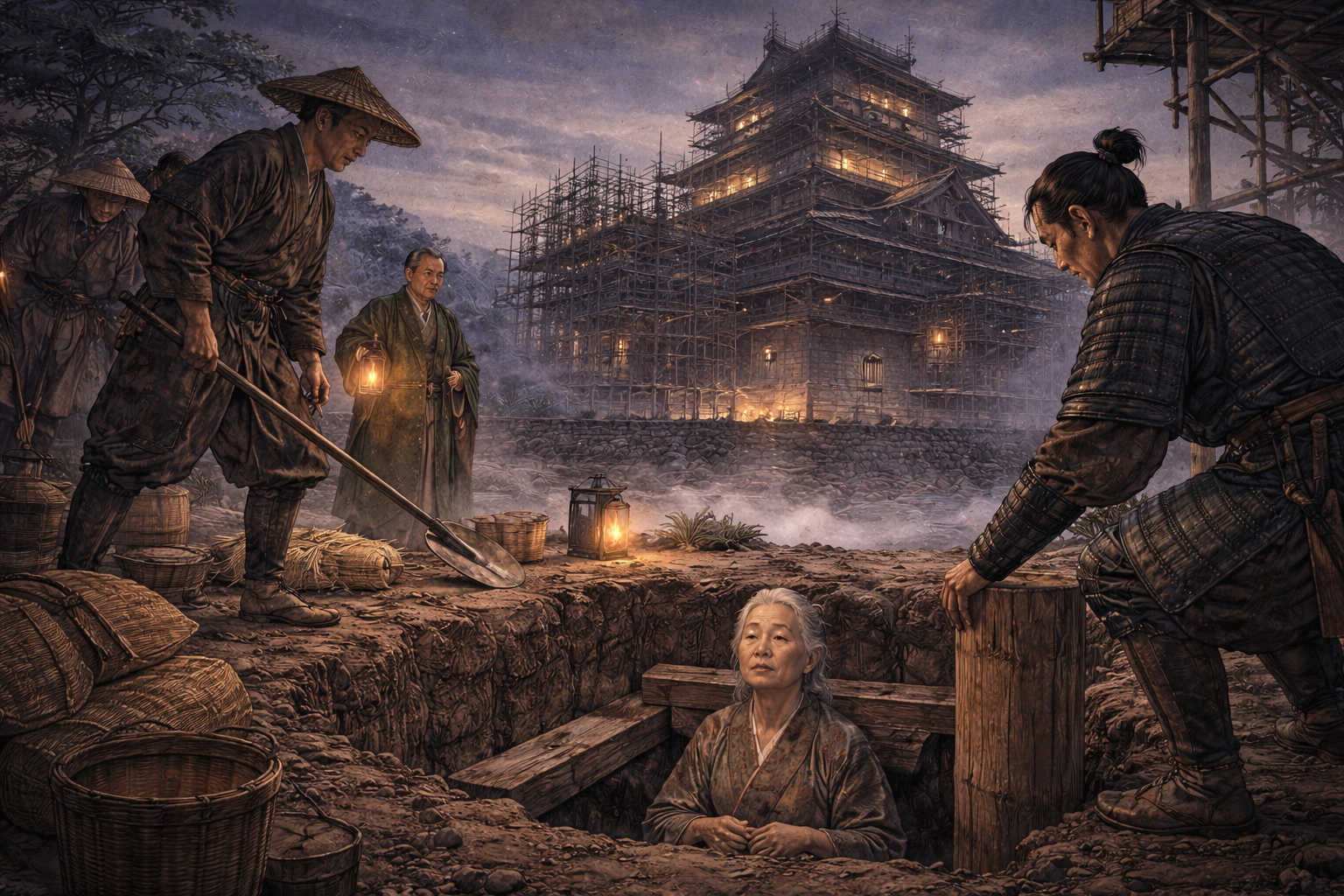
The builders worked for months, then years. Stone after stone was hauled into place. Walls rose and then collapsed. Again and again, the keep refused to stand. Every failure cost time, money, and face. In the Sengoku period, when rival clans watched for weakness, delay was not just inconvenient. It was dangerous.
The men in charge searched for reasons. The ground was unstable, some said. The design was flawed, said others. But beneath those practical explanations lay something older and harder to argue against: the land itself was angry.
In sixteenth-century Japan, land was not inert. It had memory. It had will. If a structure failed repeatedly, it was not simply bad engineering it was a sign that the spirits beneath the soil were resisting what humans were forcing upon them.
Eventually, someone spoke the word no one wanted to hear.
Hitobashira.
A human pillar.
The Logic of a Terrible Solution
Hitobashira meant burying a living person beneath a structure’s foundation to appease the local kami and stabilize the ground. To modern ears, it sounds like pure superstition. To people of the time, it was grim logic. You give the land a life, and the land gives you strength in return.
The suggestion was not made lightly. Human sacrifice was not routine, even in violent times. But the castle was strategically vital, and repeated failure demanded an explanation that went beyond tools and stone.
The person chosen was not a warrior, nor a criminal. It was a poor widow named O-shizu.
She lived at the edge of society, exactly where such decisions always landed. She had lost her husband, had only one eye, and struggled to raise two children. She had no clan to protect her, no status to shield her. In the rigid hierarchy of the Sengoku period, she was visible enough to be used and invisible enough to be forgotten.
But O-shizu was not dragged to her death.
She negotiated.
A Bargain Made in Desperation
O-shizu agreed to become the human pillar on one condition: her son would be made a samurai.
It is hard to overstate what that promise meant. Samurai status was not just a job; it was a complete transformation of one’s future. Education, income, protection, honor—everything depended on birth. For a poor widow, this was an impossible dream.
O-shizu understood something with devastating clarity. Her own life had little value in the eyes of those who ruled. But her death, properly placed, could be worth something.
This was not heroism. It was survival, redirected through sacrifice.
The agreement was accepted.
When the day came, O-shizu was buried alive beneath the central pillar of the castle keep. Legends say she went calmly. Whether that calm was courage, resignation, or shock is impossible to know. What remains is the image of a woman lowered into darkness, holding onto a promise that extended beyond her own life.
After that, the walls stopped collapsing.
The castle rose. The problem was solved.
When the Promise Was Forgotten
The keep of Maruoka Castle was completed in 1576 under the authority of Shibata Katsutoyo. From the perspective of those in power, the matter was finished.
But history did not end where the stonework did.
Soon after the castle’s completion, Katsutoyo was transferred to another province. The administration changed. Priorities shifted. And quietly, without ceremony or announcement, the promise made to O-shizu disappeared.
Her son was never elevated to samurai status. He remained poor. The bargain that had cost a woman her life was treated as expendable paperwork.
This is where the story turns.
In Japanese folklore, injustice does not vanish. It settles. It sinks into the ground. And eventually, it answers back.
The Rain That Carries a Name
People living near Maruoka Castle began to notice something strange. Every year, around April during the season when algae were cut from the moats the rain grew heavy. The water turned dark and rose higher than it should have. Fields flooded. The moat overflowed.
The locals gave the rain a name: O-shizu’s tears.
They said it was her grief rising from beneath the stone, seeping into the water, reminding the living of a debt that had never been paid. The rain was not violent. It was persistent. Like sorrow.
There were other stories too. When danger approached the castle when enemies drew near or unrest stirred a thick mist was said to gather around the walls, obscuring them from view. Because of this, Maruoka Castle came to be called Kasumi-ga-jō, the “Mist Castle.”
O-shizu, the betrayed sacrifice, had become both mourner and guardian.
This dual role is familiar in Japanese folklore. Spirits wronged by authority often become onryō, vengeful ghosts whose anger must be acknowledged and appeased. Over time, such spirits can transform into goryō protective forces tied to the very places that consumed them.
O-shizu did not leave. She remained bound to the castle that stood because of her.
A Poem That Refuses to Fade
The legend is not preserved only in stories. A short folk poem has been passed down in the region, simple and devastating in its restraint:
“The rain which falls
when the season of cutting algae comes
is the rain reminiscent of
the tears of the poor O-shizu’s sorrow.”
It does not accuse. It does not explain. It remembers.
History, Belief, and What Stands Beneath Us
From a historical perspective, the practice of hitobashira remains debated. Archaeologists have found few remains that conclusively prove human sacrifice in castle foundations. Some alleged sites have been reinterpreted as burials that predate construction.
But the persistence of these stories matters more than their literal truth.
The concept of hitobashira appears in early texts such as the Nihon Shoki, and similar legends exist across Japan bridges that demand lives, dams that will not hold without sacrifice. These stories reflect an animistic worldview in which land must be negotiated with, not dominated.
Maruoka Castle itself survived events that destroyed other structures, including the 1948 Fukui earthquake. For believers, this confirmed O-shizu’s power. For skeptics, it became another layer added to an already heavy legend.
What the story ultimately preserves is not proof of ritual sacrifice, but memory of cost.
Castles do not rise on stone alone. They rise on labor, obedience, broken promises, and lives deemed acceptable losses. O-shizu embodies all of that. She is not a warrior, not a ruler, not a name found in official records. She exists because the story insists she must.
And every time the rain comes too hard in spring, the legend reminds people that foundations—whether of buildings or societies—are never as clean as they appear.