Ubasute — The Mountain Where No One Wanted to Look Back
A story told quietly, because it is too close to real life
There are monsters in Japanese folklore with claws and fangs, and then there are stories like Ubasute, which need neither. No transformation. No curse. No spirit rising from the dead. Just hunger, fear, and a decision made too late at night, when survival feels heavier than love.
Ubasute means “abandoning an old woman.” The word itself is blunt. There is no poetry in it. And that is exactly why the story has endured.
For centuries, people have argued about whether Ubasute ever truly happened. Most historians believe it was never a widespread custom. There is little evidence that villages regularly carried their elderly into the mountains to die. But folklore does not exist to record statistics. It exists to preserve fear, guilt, and memory.
And Ubasute preserves something very human: the terror of scarcity.
The Mountain With a Name No One Wanted
The most famous version of the story is set in what is now Nagano Prefecture, at a mountain long known as Mount Kamuriki, but remembered in legend as Ubasute-yama the mountain of abandonment.
In the tale, famine looms. Crops have failed. Winter is coming. And a local lord, fearing that there will not be enough food to last, issues an order meant to be practical rather than cruel: the elderly, those who can no longer work, must be taken to the mountain and left behind.
Sometimes the decree comes from the lord. In other versions, it comes from unspoken pressure from neighbors, from hunger itself, from a society quietly agreeing that some lives are now “extra.”
The result is the same.
A son must carry his mother up the mountain.
The Walk That Takes All Night
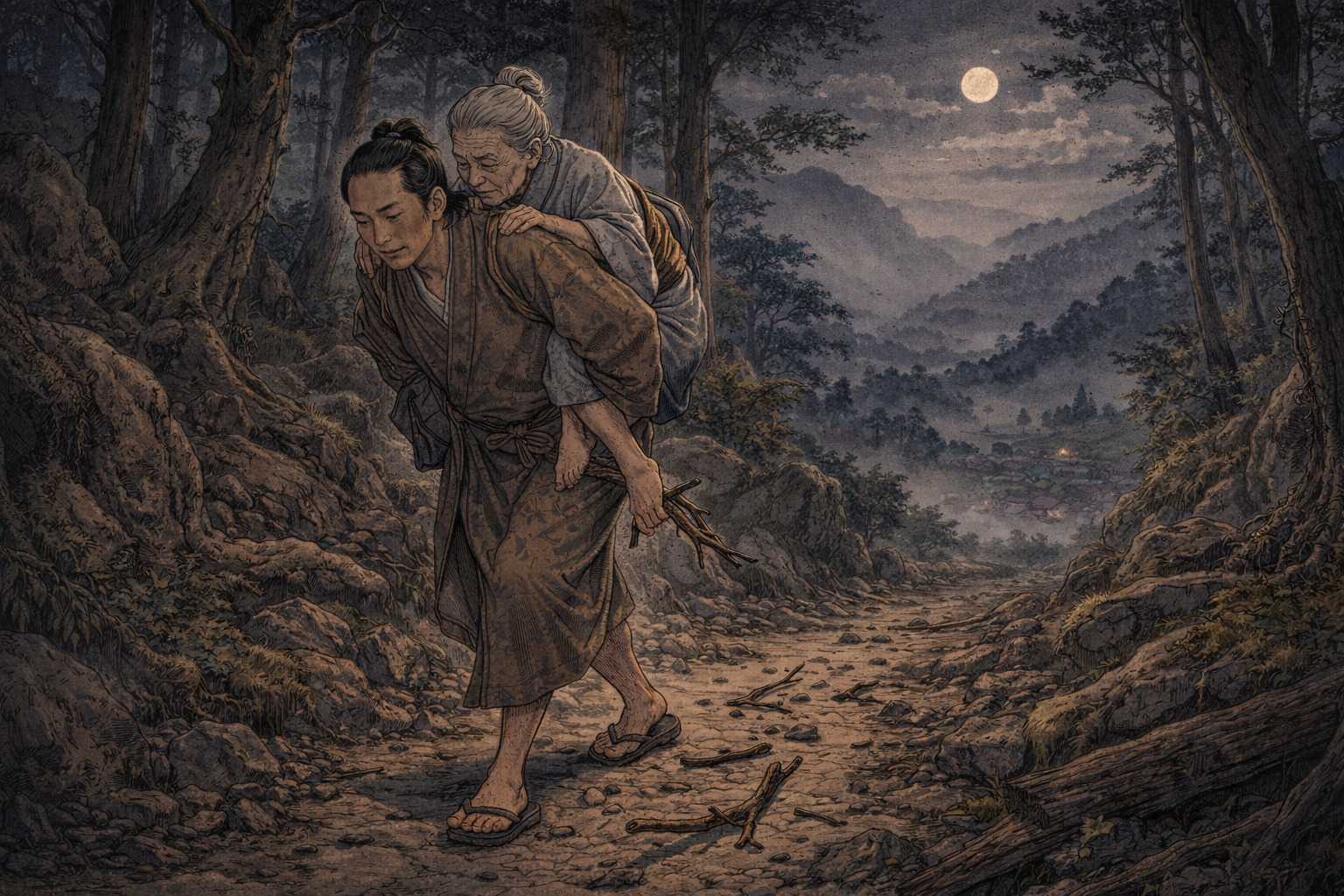
The mother is old, but not bitter. She does not scream. She does not fight. She climbs onto her son’s back and wraps her arms around him, as she once did when he was a child.
The path is steep and wooded. Moonlight filters through the trees. As they climb, the son hears branches snapping behind him. He grows uneasy. He assumes his mother is breaking twigs to mark the trail, planning to find her way back after he leaves her.
Part of him feels irritated. Another part feels ashamed for feeling irritated at all.
They reach the summit. The son sets her down. He avoids her eyes.
And only then does he ask why she was snapping the branches.
Her answer breaks the story open.
She tells him she was not marking the path for herself. She was marking it for him. So that when he walks back down alone, in the dark, he will not lose his way.
Even now especially now she is thinking of his safety.
The Moment That Cannot Be Undone
This is the moment Ubasute turns from horror into something worse: recognition.
The son realizes that the person he is abandoning is still being a mother. Still protecting him. Still choosing him over herself, even when there is nothing left to give.
In some versions of the story, he recites a poem on the mountain, words that later generations remembered:
In the depths of the mountains,
for whom did my aged mother snap
twig after twig?
Thinking not of herself,
she did so for her child.
He lifts her back onto his shoulders and carries her home.
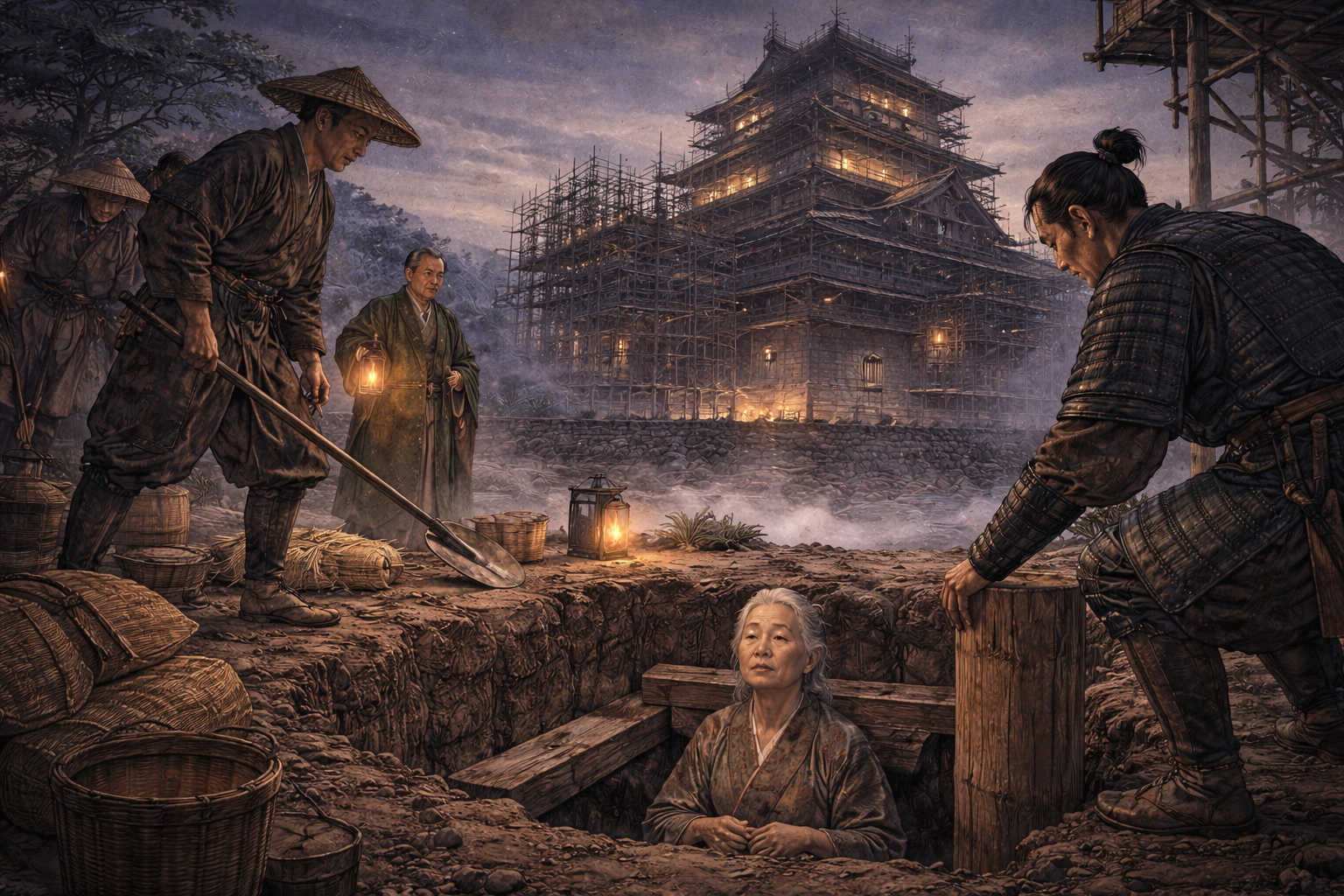
He hides her beneath the floor of his house, feeding her secretly, defying the order that told him she was no longer useful.
When Wisdom Becomes the Only Weapon
In many versions, the story does not end there.
The lord who issued the decree soon faces a crisis sometimes a threat from a neighboring ruler, sometimes a demand from a cruel authority, sometimes riddles posed by a god. The challenge is impossible. If the lord fails, the village will be destroyed.
The riddles are strange and cruel in their own way:
“Make a rope from ash.”
“Thread a string through the spiral of a twisted conch shell.”
The young men of the village cannot solve them. Strength is useless here.
In desperation, the son asks his hidden mother.
She does not hesitate.
To make a rope of ash, she says, twist straw into a rope, soak it in salt water, and burn it carefully. The ash will hold the rope’s shape.
To thread the shell, tie the string to an ant and place honey at the other end. The ant will carry the thread through.
The solutions save the village.
And the lord realizes something he should have known all along.
What Was Almost Lost
The decree is abolished. The elderly are welcomed back. The story closes not with punishment, but with shame shame directed not at one villain, but at an entire way of thinking.
Ubasute is not about cruelty for cruelty’s sake. It is about logic taken too far. About survival stripped of memory. About a society that mistakes usefulness for worth.
This is why the story appears so early, in works like Yamato Monogatari, and why it continued to resonate centuries later, eventually inspiring modern retellings such as The Ballad of Narayama. Each generation retells it because each generation fears becoming either the son or the mother.
The Moon That Watches Without Judgment
Folklorist Yanagita Kunio suggested that Ubasute may have roots in Buddhist stories of filial piety, adapted to the harsh realities of rural Japanese life. Whether or not senicide ever occurred, the anxiety behind the story was real. Peasant life balanced constantly on the edge of famine. Choices were brutal. Not everyone survived.
What makes Ubasute linger is the image of Ubasute no Tsuki the moon shining down on the mountain. The moon does not intervene. It does not judge. It simply witnesses.
That moon has watched countless human decisions made under pressure: who eats, who starves, who is carried, who is left behind.
In modern Japan an aging society once again struggling with how to care for its elderly the story feels uncomfortably close. Ubasute is not about a barbaric past. It is about a temptation that never fully disappears.
And that is why the old woman snaps the twigs.
Not to come back.
But so her child does not lose his way.