Takiyasha-hime and the Starving Skeleton
A rebellion that refused to stay buried
Long before the image of a towering skeleton entered anime, manga, and video games, it belonged to a much older story one rooted in political rebellion, grief, and the quiet anger of the forgotten dead. The monster now known as the Gashadokuro did not begin as a named yōkai or a neat entry in a bestiary. It emerged slowly, pieced together from history, folklore, and art. And at its center was not a skeleton, but a woman who refused to let her father’s defeat be the end of his story.
Her name was Takiyasha-hime.
A Father Who Challenged Heaven
The story begins in the mid–10th century, during the Heian period, when Japan was ruled from Kyoto by an imperial court that claimed divine authority. In the eastern provinces, far from that court’s rituals and poetry, lived a powerful warrior named Taira no Masakado.
Masakado was not a bandit or a rogue general. He was a landholder with popular support, someone who openly challenged the political order. In 939, he did something unthinkable: he declared himself Shinnō the “New Emperor.” It was an act of open rebellion against the throne, and it terrified the capital.
The response was swift. Imperial forces crushed the uprising. Masakado was killed, beheaded, and his head was taken to Kyoto as proof that the rebellion was over.
According to legend, it was not.
Stories soon spread that Masakado’s severed head refused to decay. Worse, it screamed at night, demanding its body. Eventually, the head is said to have flown back east, landing in what is now central Tokyo. Whether believed or not, the story captured something real: Masakado’s rebellion had failed, but his defiance lingered.
He left behind a daughter.
Takiyasha-hime After the Fall
Historically, Takiyasha-hime was likely a noblewoman who lived quietly after her father’s defeat, perhaps becoming a nun. Folklore, however, was not interested in quiet endings.
In legend, Takiyasha-hime becomes the living remainder of Masakado’s rebellion—the person who inherits not his army, but his anger. With her clan destroyed and her family disgraced, she retreats to the ruins of Sōma Palace, her father’s former stronghold in the east.
This is where the story turns.
Rather than accepting defeat, Takiyasha-hime seeks power. She is said to travel to sacred and dangerous places sometimes Kifune Shrine, sometimes Mount Tsukuba—where she performs forbidden rituals. These rites are often described as ushi no koku mairi, a curse ritual conducted in the dead of night, demanding endurance, isolation, and rage.
What answers her prayers is not a god, but knowledge.
She learns gama-majutsu, frog or toad magic, a form of sorcery associated with transformation, summoning, and the boundary between life and death. In Japanese symbolism, frogs (kaeru) are linked to “returning” a wordplay that fits her desire perfectly. She wants her father’s honor returned. She wants the past to rise again.
And it does.
Skeletons That Remember Hunger
Takiyasha-hime does not summon demons from another realm. She raises what already lies beneath the ground.
The dead she calls forth are those who died badly soldiers killed in battle, peasants who starved during unrest, bodies left unburied and unmourned. Their bones gather. Their resentment accumulates. From this mass of suffering emerges a single, towering shape: a giant skeleton, vast beyond human scale.
This creature was not originally called the Gashadokuro. In older sources, it is simply an ō-dokuro a great skeleton. Its horror lies not in speed or cunning, but in inevitability. It cannot be reasoned with. Weapons pass through it. It exists because too many people were allowed to die without closure.
Later folklore gives it specific traits. It is said to be invisible until the moment it strikes. Victims hear a strange ringing in their ears mimi-nari just before it appears. Its teeth chatter with a dry, clicking sound: gachi, gachi. That sound would eventually give the monster its modern name.
The skeleton is not a servant in the usual sense. Takiyasha-hime does not command it like an obedient soldier. She releases it.
The Battle That Became an Image
The climactic confrontation in the legend pits Takiyasha-hime against an imperial warrior sent to erase the last trace of Masakado’s line: Ōya no Tarō Mitsukuni. In earlier versions of the story, Takiyasha summons many skeletons to overwhelm him. The emphasis is on chaos and persistence rather than spectacle.
That changes in the 19th century.
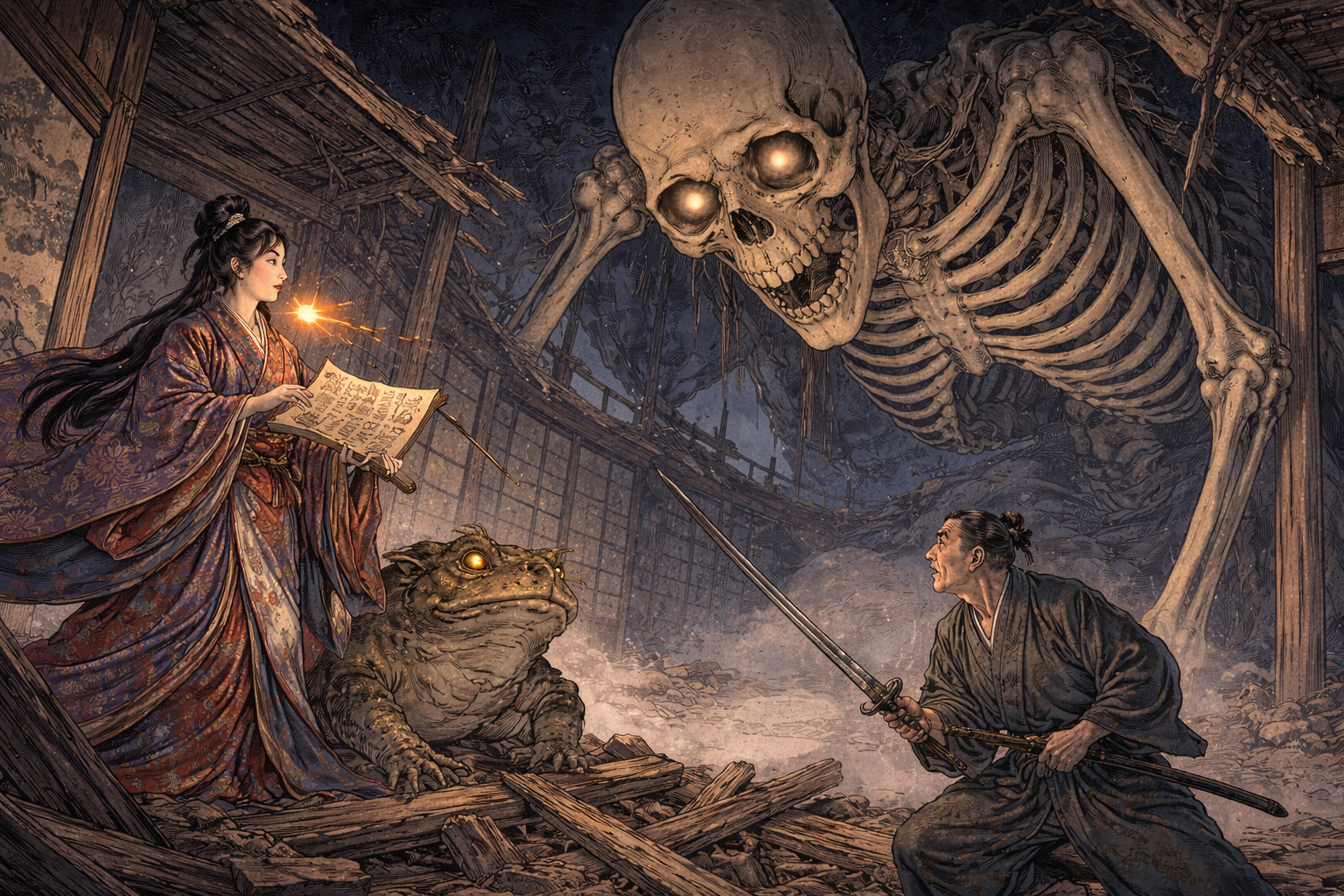
Around 1844, the ukiyo-e artist Utagawa Kuniyoshi created a woodblock print titled Takiyasha the Witch and the Skeleton Spectre. In it, Takiyasha-hime stands calmly in the foreground, reading from a scroll. Behind her, a single colossal skeleton bursts through bamboo blinds, its skull nearly filling the frame.
This was not strict folklore it was artistic invention.
Kuniyoshi combined many skeletons into one, not to change the story’s meaning, but to make it unforgettable. The image worked. It burned itself into cultural memory. From that point on, the idea of a single, gigantic skeleton took precedence over older versions.
Decades later, encyclopedias of yōkai particularly those influenced by Shigeru Mizuki gave the creature a fixed name: Gashadokuro.
The monster had been classified. But its origin remained political and human.
What the Gashadokuro Really Represents
Despite its monstrous appearance, the Gashadokuro is not a predator in the usual sense. It does not stalk for pleasure. It is formed from people who were never meant to be remembered.
This is why Takiyasha-hime matters more than the skeleton.
Unlike figures such as O-shizu, who become spirits through betrayal and suffering, Takiyasha-hime chooses action. She does not wait for justice. She creates a weapon out of the consequences of war. The skeleton is not her rage alone it is collective rage, shaped into form.
In this way, the legend becomes quietly radical. The dead do not accuse the state with words. They rise up and bite its representatives in half.
Takiyasha-hime herself fits the archetype of the Japanese “witch”: a woman whose grief becomes power, whose loyalty to family overrides loyalty to authority. She is dangerous not because she is evil, but because she refuses to forget.
A Monster Born From Memory
The Gashadokuro feels ancient, but its final shape is modern. It is a reminder that folklore evolves, absorbing history, art, and anxiety as it goes. What began as a rebellion became a ghost story. What began as many skeletons became one.
And behind it all stands Takiyasha-hime reading her scroll, torch in her mouth, unafraid.
The skeleton looms, but she does not look back.
Because the dead, once raised, already know who they are angry at.