The Foot That Came Through the Ceiling
A true Edo-period legend, told the way people might have whispered it
In old Edo, in a neighborhood where samurai families lived behind clean gates and carefully swept streets, there was a house people learned not to walk past at night. It looked ordinary in daylight tile roof, wooden beams, a garden kept just neat enough to signal status. But after dark, something inside that house refused to stay contained.
This was the Ashiarai Yashiki, the Foot-Washing Mansion.
The house belonged to Aji no Kyūnosuke, a hatamoto a man close enough to the shogun that people lowered their eyes when he passed. His household ran on routine. Servants knew their places. Doors slid when they were told. Nothing was out of order.
Until the nights when the voice came.
It did not whisper. It did not moan. It boomed, shaking the beams of the house like distant thunder.
“Wash my foot.”
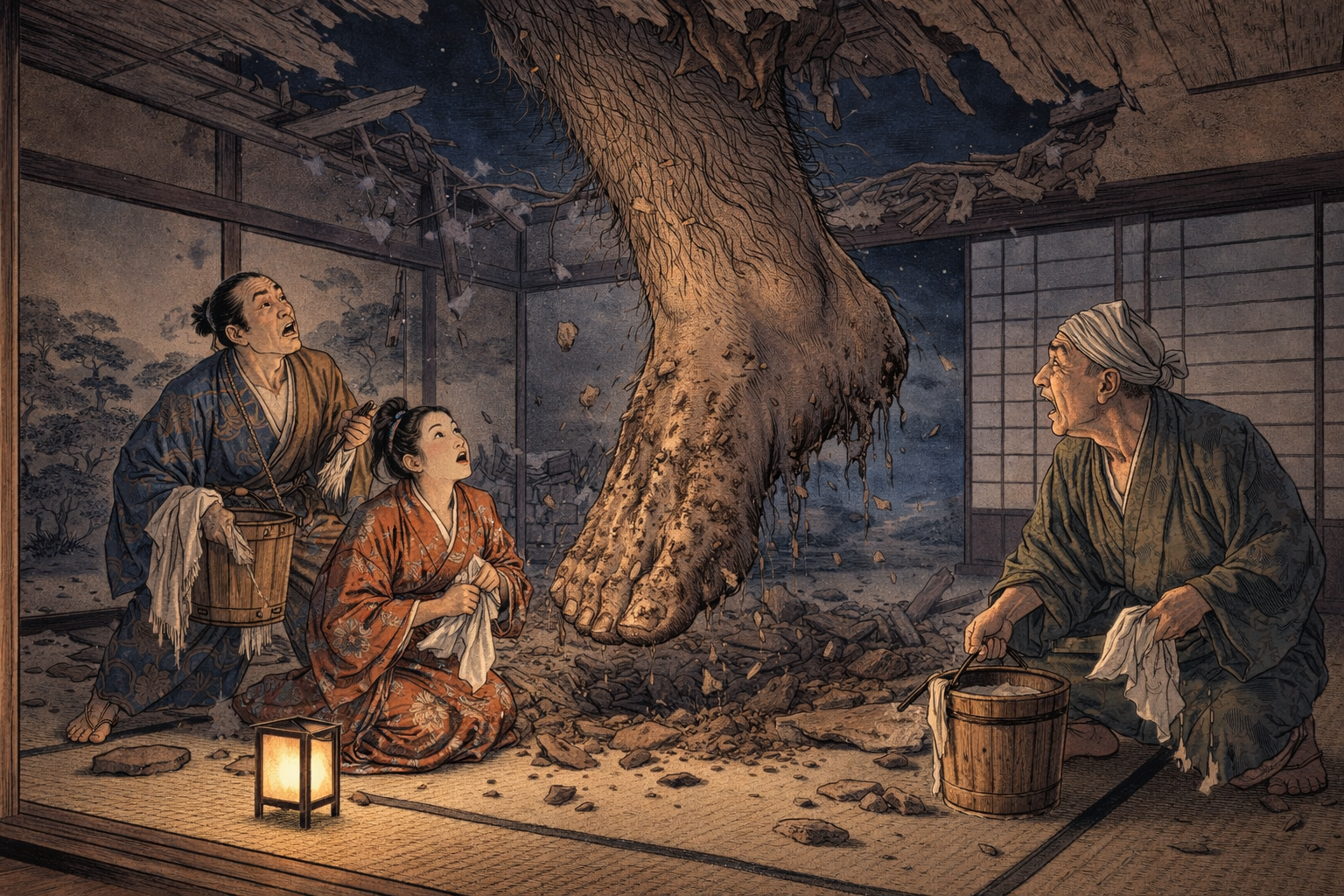
Before anyone could speak, the ceiling cracked. Wood split apart with a sound like a tree breaking in a storm. Dust poured down. And then slowly, impossibly an enormous foot pushed through the roof.
It was human in shape, but far too large. The skin was rough. Coarse hair covered it. Mud clung between the toes, dark and wet, as if it had walked straight out of a riverbank and into the sky above the house.
No body followed it. Just the foot, hanging there, waiting.
The servants froze. Some wept. Some prayed. But none of them ran.
They did what they had been trained to do their entire lives. They obeyed.
Buckets were filled. Cloths were soaked. Kneeling beneath the hole in the ceiling, they scrubbed the foot clean. When the last streak of mud was gone, the foot slowly withdrew. The broken boards slid back into place. The house fell silent.
The next night, it happened again.
And the night after that.
The strangest part was not the foot itself. It was how quickly the household adapted. Washing the foot became another task, like sweeping the corridor or warming bathwater. Terror turned into routine. The impossible became just another obligation.
Eventually, Kyūnosuke had enough. He ordered his servants to do nothing.
When the voice returned and no one moved, the foot slammed down violently, smashing the roof, scattering debris across the tatami mats. The house shook. But then—nothing. The foot vanished and never came back.
The damage, however, remained. Kyūnosuke abandoned the house, swapping it with another samurai. And just like that, the haunting ended. The foot never appeared for the new owner.
People in Edo laughed nervously when they told the story. Some said it was a tanuki, playing a cruel joke. Others said the foot came to shame a powerful man who needed to “wash his feet” and clean up his life.
Either way, the lesson was clear: even in a city ruled by rank and order, something filthy and absurd could crash through your ceiling and demand service.
The Woman Beneath the Castle
A story remembered every time the rain comes
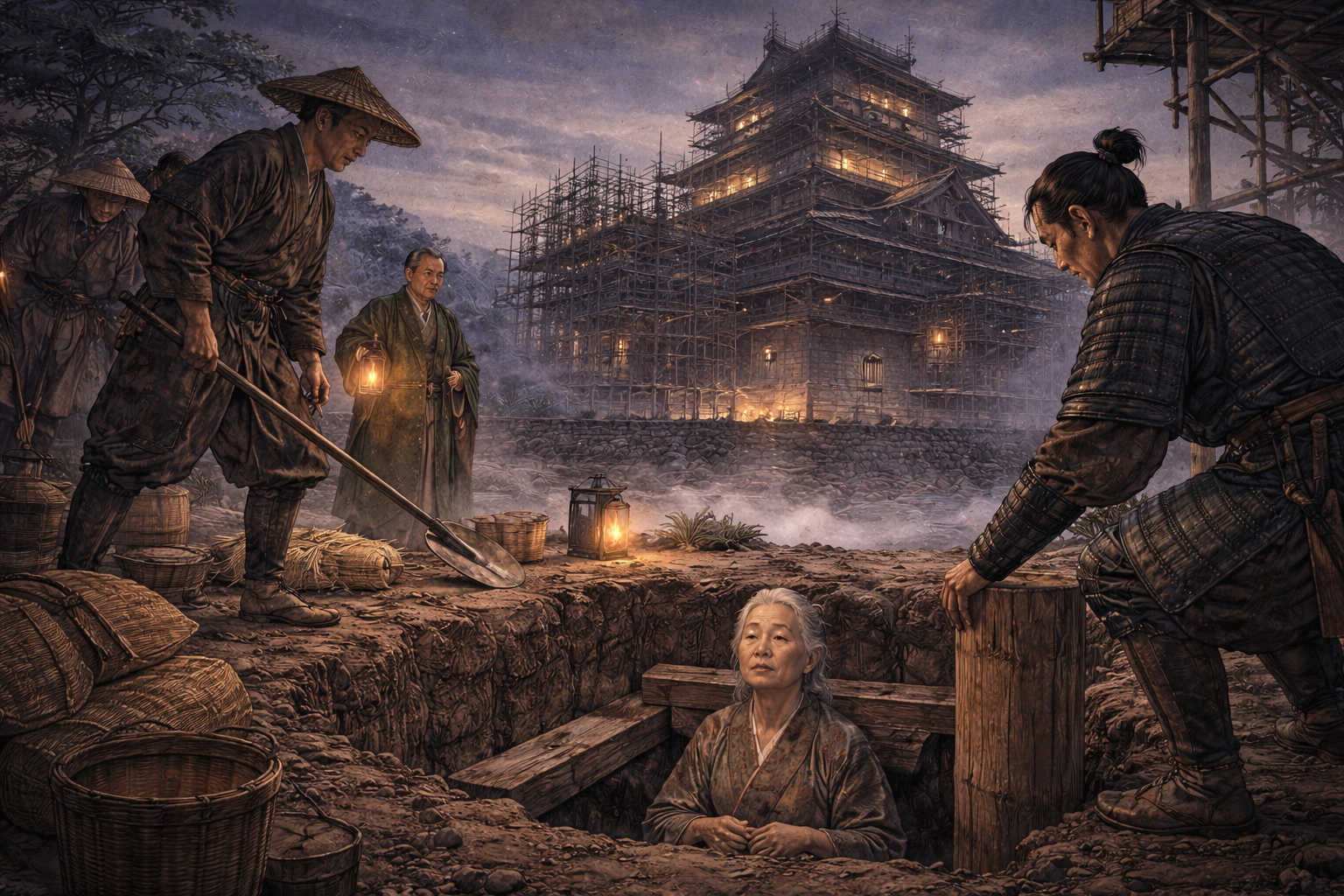
Far from Edo’s busy streets, in Fukui Province, stands Maruoka Castle. It is not the grandest castle in Japan, but it has always been known for one thing: it stands when others fall.
The legend says that when the castle was first built in the late 1500s, it refused to stay upright. Walls collapsed again and again. The builders blamed the land. The spirits beneath the soil, they said, were angry.
Someone proposed a solution no one wanted to name out loud.
A hitobashira a human pillar.
The person chosen was a poor widow named O-shizu. She had one eye and two children, and nothing else. She was not dragged screaming to her death. She agreed.
Her price was simple. Make her son a samurai.
That promise mattered. In a world where birth decided everything, this was a chance to break the ceiling that had trapped her family in poverty.
O-shizu was buried alive beneath the central pillar of the castle. The walls stopped collapsing. The castle was completed.
And then the promise was forgotten.
The lord who had sworn it was transferred elsewhere. O-shizu’s son remained poor. Her sacrifice became just another stone hidden beneath the floor.
That is when the rain began.
Every year, when spring comes and the algae are cut from the moats, the rain falls harder than it should. The water turns dark. The people say it is O-shizu’s tears, weeping for a bargain that was never honored.
They also say that when danger approaches the castle, a thick mist rises, hiding it from view. O-shizu, betrayed and buried, still protects the place that consumed her.
What These Stories Leave Behind
One story is strange, almost funny a giant foot demanding to be washed. The other is quiet and devastating a woman traded for stone and stability.
But both come from the same place.
They are stories about living inside systems too large to escape. About obedience turning into habit. About people whose lives become part of the structure, whether they agree to it or not.
In Edo Japan, houses could be haunted and castles could stand on human bones. The city laughed at one story and mourned the other.
And every time the rain falls too hard, or a ceiling creaks at night, people remember that what is buried does not always stay silent.