The Basajaun: Lord of the Woods and Keeper of Forgotten Ways
The Basajaun: Lord of the Woods and Keeper of Forgotten Ways
Deep in the shadowed forests and high pastures of the Basque Country, there are places where the wind seems to whisper and the trees feel watchful. In Basque folklore, that feeling has a name: the Basajaun. Known in the plural as Basajaunak, these beings are among the oldest and most meaningful figures in Basque mythology. Their name comes from basa (wild, forest) and jaun (lord), and together they form a title rather than a name “Lord of the Woods.”
Unlike many European “wild men,” the Basajaun is not a mindless brute or a cursed human. He is powerful, ancient, and deeply tied to the land itself. Sometimes feared, sometimes respected, and sometimes tricked, the Basajaun represents the uneasy relationship between humans and the natural world they once depended on for survival.
A Giant Shaped by Forest and Stone
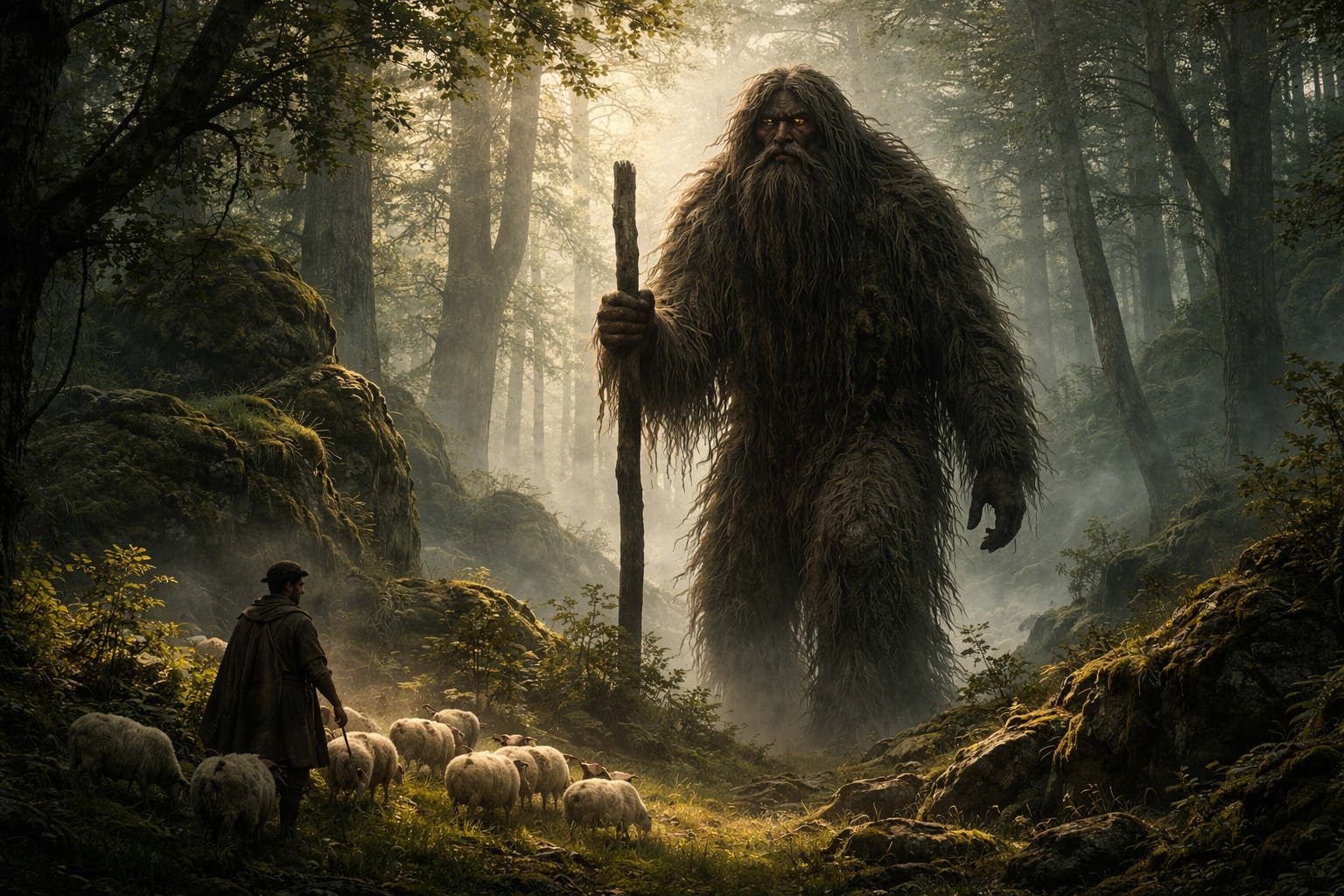
Stories from Navarre, Gipuzkoa, and the French Basque valleys describe the Basajaun as a towering humanoid giant, broader and stronger than any ordinary man. His strength is legendary, but it is never portrayed as random violence. Instead, it feels elemental, like the strength of mountains or storms dangerous if challenged, protective if respected.
The Cloak of Hair
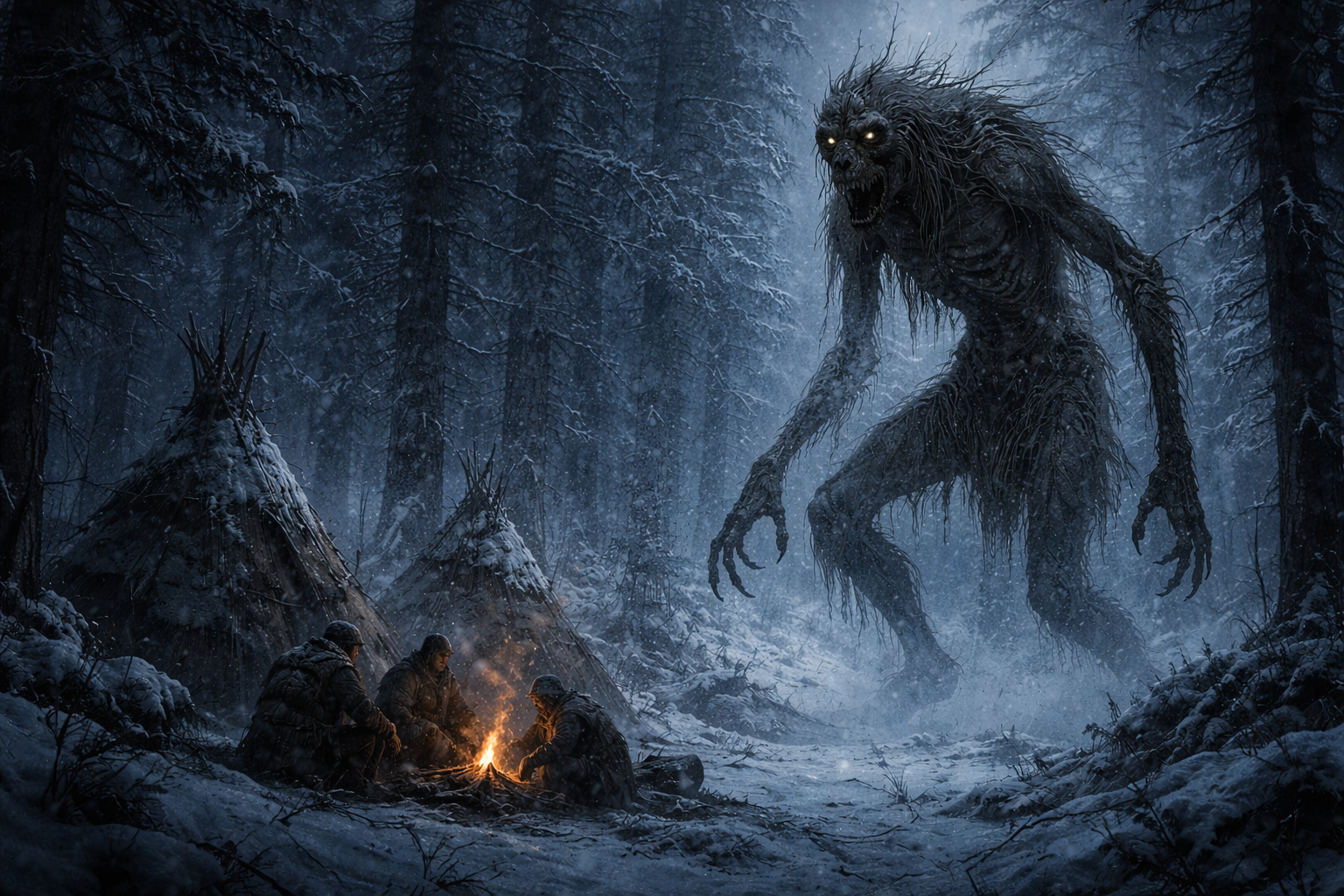
The most striking feature of the Basajaun is his hair. He is covered from head to toe in a thick, shaggy coat that hangs down to his knees. This hair acts as clothing, armor, and identity all at once. It protects him from thorny undergrowth, cold mountain winds, and harsh winters in the Pyrenees. Far from being grotesque, this hair marks him as a being perfectly adapted to the wild, untouched by human comforts because he has no need for them.
The Uneven Foot
One small but important detail appears again and again in oral tradition: the Basajaun’s feet are not the same. One is shaped like a human foot, while the other is round, leaving a strange circular footprint. This detail matters because it allows hunters and shepherds to tell his tracks apart from those of bears or wandering humans. Symbolically, it shows what the Basajaun truly is part human, part something older, balanced between the familiar and the unknown.
The Giant Who Had Knowledge Before Humans Did
In Basque mythology, civilization does not begin with gifts from gods. It begins with theft.
The Basajaun is said to have known the secrets of agriculture, metalworking, and tools long before humans did. He was the first miller, the first farmer, the first craftsman. Humans survived at first by hunting and gathering, while the Basajaunak farmed the mountains and understood the rhythms of the land.
The one who changes this balance is San Martin Txiki, a small but clever trickster figure. Though his name sounds Christian, in these stories he behaves less like a saint and more like a folk hero whose sharp mind compensates for his lack of strength.
How Humans Learned to Farm
One of the most important Basajaun legends explains how humans learned agriculture.
According to the tale, the Basajaunak grew wheat high in the mountains, near places like Muskia Mountain in Ataun. San Martin Txiki visits their cave and sees huge piles of harvested grain. He dares to jump over them without touching them, wearing boots that are far too large. When he lands in the wheat, the giants laugh and chase him away—never noticing that grains have fallen into his boots.
But seed alone is useless without knowledge. Later, Martin listens outside the cave and hears a Basajaun singing a simple song. Hidden in its verses is the farming calendar: when to sow wheat, corn, and turnips. The song is memorable, rhythmic, and practical exactly how important knowledge survived in oral cultures.
Through this story, farming becomes not a divine blessing, but a hard-won secret taken from nature itself.
Learning from Leaves: The First Saw
Another legend explains the invention of the saw. Martin claims he has created a tool that can cut wood with ease. The Basajaun, suspicious and annoyed, asks one question: “Has your master seen the leaf of the chestnut tree?”
When Martin hears this, he understands immediately. He studies the serrated edge of the leaf and copies its pattern into iron. The saw is born not from imagination, but from observing nature.
In a final twist, the Basajaun tries to ruin the tool by bending the teeth alternately left and right. Instead of breaking it, he improves it. The saw cuts better and no longer sticks in the wood. Once again, human progress comes from watching nature and surviving the consequences of conflict with it.
Fire, Iron, and Clay Water
Similar stories explain how humans learned to weld iron. When Martin boasts about joining metal, the Basajaun asks whether he used water mixed with potter’s clay. That hint clay water acting as a primitive flux gives humans the final piece they need.
Together, these tales paint a clear picture: humans are not stronger than the Basajaun, but they are observant, adaptable, and persistent. Technology comes not from domination, but from learning and sometimes stealing from the wild.
Protector of Shepherds and Flocks
Despite these stories of rivalry, the Basajaun is not an enemy of humans. In pastoral folklore, especially among shepherds, he is a guardian.
High in the summer pastures of the Pyrenees, wolves and bears once posed constant danger. Folklore says that predators would not attack flocks guarded by a Basajaun. His presence alone marked territory as dangerous to cross.
The Basajaun also warned shepherds of approaching storms. His thunderous roar across the mountains was not a threat, but a warning time to gather the sheep and descend to safety.
This protection required respect. Shepherds left food bread, cheese, or curds on stones near caves. If the offering was gone by morning, the agreement continued. It was an unspoken contract: humans could share the land, but only if they remembered whose land it was first.
A Memory Older Than History?
There is an idea that comes up from time to time when people talk about the Basajaun, usually spoken carefully and without much certainty. What if this figure isn’t just a symbol but a very old echo?
Some researchers and folklorists have suggested that stories of the Basajaun might preserve a distant cultural memory of encounters between early modern humans and Neanderthals in the mountains of northern Iberia. Not a record, not a history just a shadow. The Basajaun is always described as stronger than humans, broader, heavier, built for cold and stone. He lives in caves. He knows the land completely, while humans are still learning how to survive on it.
There is no way to prove anything like this, and no serious scholar would claim the legend is literal. Still, the Basque region is unusual. The Basque language, Euskara, does not belong to the Indo-European family at all. It stands alone, hinting at a continuity of people and culture that reaches far deeper into the past than most of Europe can trace.
Whether the Basajaun reflects real encounters or not almost becomes secondary. What matters is what he represents the sense that someone else was there first. Someone stronger. Someone who understood the mountains before fields, the forests before villages. In the stories, humans don’t inherit the land they take it, slowly, and not without resistance.