The Enigma of the Utsuro-bune (The Hollow Ship)
On a cold day in early 1803, fishermen along Japan’s eastern coast pulled something from the sea that did not belong there. It was not a wrecked boat, nor a drifting log, nor a foreign ship in any recognizable sense. It was sealed, rounded, and silent. The men who hauled it ashore could look inside but could not understand what they were seeing.
This incident, remembered as the Utsuro-bune (“hollow ship”), occupies an unusual place in Japanese history. It is neither a simple folktale nor a confirmed historical event in the modern sense. Instead, it survives in the margins of Edo-period scholarship: recorded, measured, debated, but never resolved. What makes the story compelling is not how strange it is, but how restrained it feels. No miracles occur. No monster reveals itself. People observe, speculate, make a decision and live with it.
A Story Preserved, Not Invented
The Utsuro-bune does not come from a single storyteller embellishing a rumor. It appears across several late Edo texts, including Toen Shōsetsu (1825) by Kyokutei Bakin, as well as Hyōryū Kishū (1835) and Ume-no-chiri (1844). These works belong to a genre concerned with oddities and unexplained events earthquakes, strange animals, rumors from distant provinces. Their authors did not treat such material as fantasy, but as curiosities worth recording.
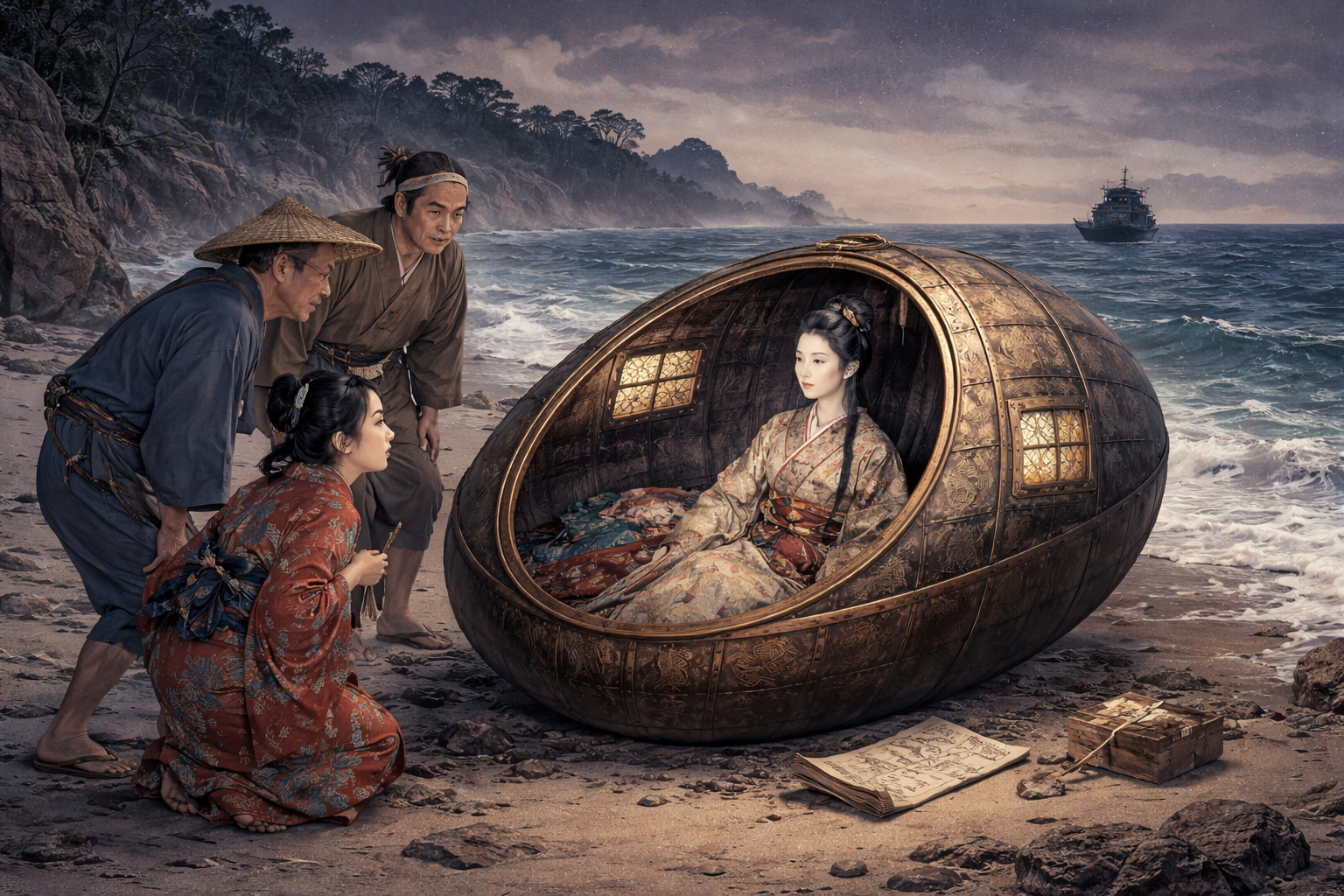
Across these sources, the outline of the event barely changes. On February 22, 1803, villagers in the Harayadori area of Hitachi Province today part of Ibaraki Prefecture noticed an unfamiliar object drifting offshore. It was brought onto the beach so it could be examined. What followed was not panic, but careful observation.
That consistency matters. It suggests that, whatever the truth of the event, the writers believed they were preserving something that had genuinely happened or at least something that many people believed had.
The Vessel as an Object, Not a Symbol
Descriptions of the Utsuro-bune are surprisingly concrete. The craft was round, compared to a lidded incense burner or a rice container. It measured roughly five and a half meters across and a little over three meters high large enough for a person, but not designed for comfort or movement.
The materials stood out immediately. The upper portion was described as red-lacquered wood, something decorative rather than practical. The lower section was reinforced with metal plating, likely iron or bronze. For coastal villagers in 1803, this detail alone was unsettling. Metal-plated hulls were not part of Japanese shipbuilding at the time.
Even more unusual were the windows. Transparent panels described as glass or crystal were set into the sides and sealed with resin. Through them, the fishermen could see the interior. Japanese boats were not built to be looked into. This vessel invited observation while resisting access.
The Utsuro-bune did not behave like a ship. It did not sail. It drifted. It felt less like transportation and more like containment.
The Woman Inside
Inside the vessel sat a young woman, estimated to be around eighteen or twenty years old. She was not unconscious, injured, or hostile. She was simply there.
The accounts emphasize how difficult she was to place. Her skin was pale, her hair and eyebrows reddish. Edo-period texts often used “red hair” as a shorthand for Europeans, but the descriptions go further. Her hairstyle included long white elements possibly extensions, fur, or some unknown ornamentation that the villagers had never seen before.
Her clothing was equally unfamiliar. It was described as close-fitting and made of fine material, unlike the layered, flowing garments common in Japan. She spoke constantly, but her language was completely unintelligible. No shared words, gestures, or symbols bridged the gap.
Most striking was the box she carried. A square wooden container, roughly sixty centimeters across, which she clutched tightly whenever anyone approached. She would not allow it to be touched. The villagers could not open it, examine it, or even properly discuss it with her.
Inside the vessel, they also found food cakes or kneaded provisions, preserved meat, water as well as soft carpets and a finely decorated cup. These details suggest preparation, not accident. Whatever the Utsuro-bune was, it was meant to sustain life for some time.
Symbols Without a Key
The interior walls were marked with strange symbols. They were not random scratches. They were copied carefully into manuscripts, indicating that observers believed they mattered.
Modern readers often jump to extraordinary conclusions here, but Edo-period scholars did not. They simply noted that the markings did not resemble Japanese writing. Later interpretations have suggested connections to Western alchemical symbols, Buddhist Sanskrit characters, or distorted Roman letters possibly seen on foreign objects that washed ashore.
What matters more than their origin is their effect. The symbols made interpretation impossible. They denied the villagers even the comfort of misreading. The woman, her vessel, and her writing remained closed systems.
Fear, Policy, and the Limits of Curiosity
The Utsuro-bune appeared during Japan’s policy of Sakoku, when contact with foreigners was tightly restricted. By the early nineteenth century, rumors of Russian and British ships near Japanese waters were already circulating. Foreign presence was not theoretical; it was a growing anxiety.
Faced with the woman, the villagers tried to explain her using the social logic they knew. Some speculated she was a foreign noblewoman, exiled for a scandal. The box, they whispered, might contain the head of a lover a grim but familiar punishment in Edo society.
This interpretation is telling. It does not demonize her. It makes her tragic. It turns an incomprehensible encounter into a story of shame and loss, something human beings can recognize.
In the end, practicality overruled curiosity. Reporting the incident to authorities could bring investigation and punishment. The safest option was to erase the problem. The villagers placed the woman back inside the Utsuro-bune and pushed it back out to sea.
No rescue. No imprisonment. No explanation. Just removal.
Folklore, Drift, and an Unanswered Question
Later folklorists, including Yanagita Kunio, would argue that the Utsuro-bune fits into older “drift” legends stories in which strangers arrive from the sea, sometimes bearing blessings, sometimes disruption. In that sense, the tale is not unique.
And yet, it is different. The measurements, materials, and tone feel modern. The story reflects a society on the edge of contact with a wider world, struggling to interpret unfamiliar technology through older narrative forms.
The Utsuro-bune does not offer closure. The woman’s fate is unknown. The box is never opened. The symbols are never read. What remains is a record of hesitation a moment when people encountered something they could not classify and chose caution over understanding.
That choice, quiet and human, may be the most believable part of the story.