The Kratt: The Artificial Servant of Estonia
Leaving the high mountains and ancient forests of southern Europe behind, the landscape of northeastern Europe flattens into wetlands, bogs, and dark pine woods. In Estonia, the land itself feels engineered by water and decay ditches, fields, and marshes carefully maintained against collapse. It is here, in this environment of scarcity and improvisation, that one of Europe’s most unsettling folkloric figures emerges: the Kratt.
The Kratt is not a spirit born of nature, nor a beast of flesh and blood. It is artificial. Built by human hands from household trash and animated through a pact with the devil, the Kratt exists for a single purpose to work. More specifically, to steal. Known in Estonian as a varavedaja, or “treasure-bearer,” the Kratt is folklore’s answer to economic desperation: a tireless servant engineered to enrich its master by draining the wealth of others.
In many ways, the Kratt feels startlingly modern. It is a pre-industrial machine, governed by rigid logic, incapable of moral judgment, and ultimately dangerous to its creator.
Poverty, Serfdom, and the Zero-Sum World
To understand why the Kratt exists, one must understand the historical position of the Estonian peasantry. For centuries, native Estonians lived under foreign rule first by Germanic crusader-knights, then Swedish kings, and later Russian tsars. Land ownership was concentrated in manor houses controlled by elites who did not share language, culture, or ancestry with the people who worked the fields.
Serfdom defined rural life. Wealth accumulation through honest labor was nearly impossible. Grain, livestock, and money flowed upward; little came back down.
In this zero-sum economy, where survival often depended on cunning rather than fairness, the Kratt emerged as a fantasy of redistribution. Crucially, the Kratt does not create wealth. It steals it. Milk is siphoned from neighboring cows, grain vanishes from barns, coins disappear from locked chests. The Kratt embodies the belief that if the system itself is unjust, theft becomes a rational if dangerous solution.
The Kratt is not heroic. It is practical.
Building a Servant from Scraps
A Kratt is never summoned by spell alone. It must be constructed.
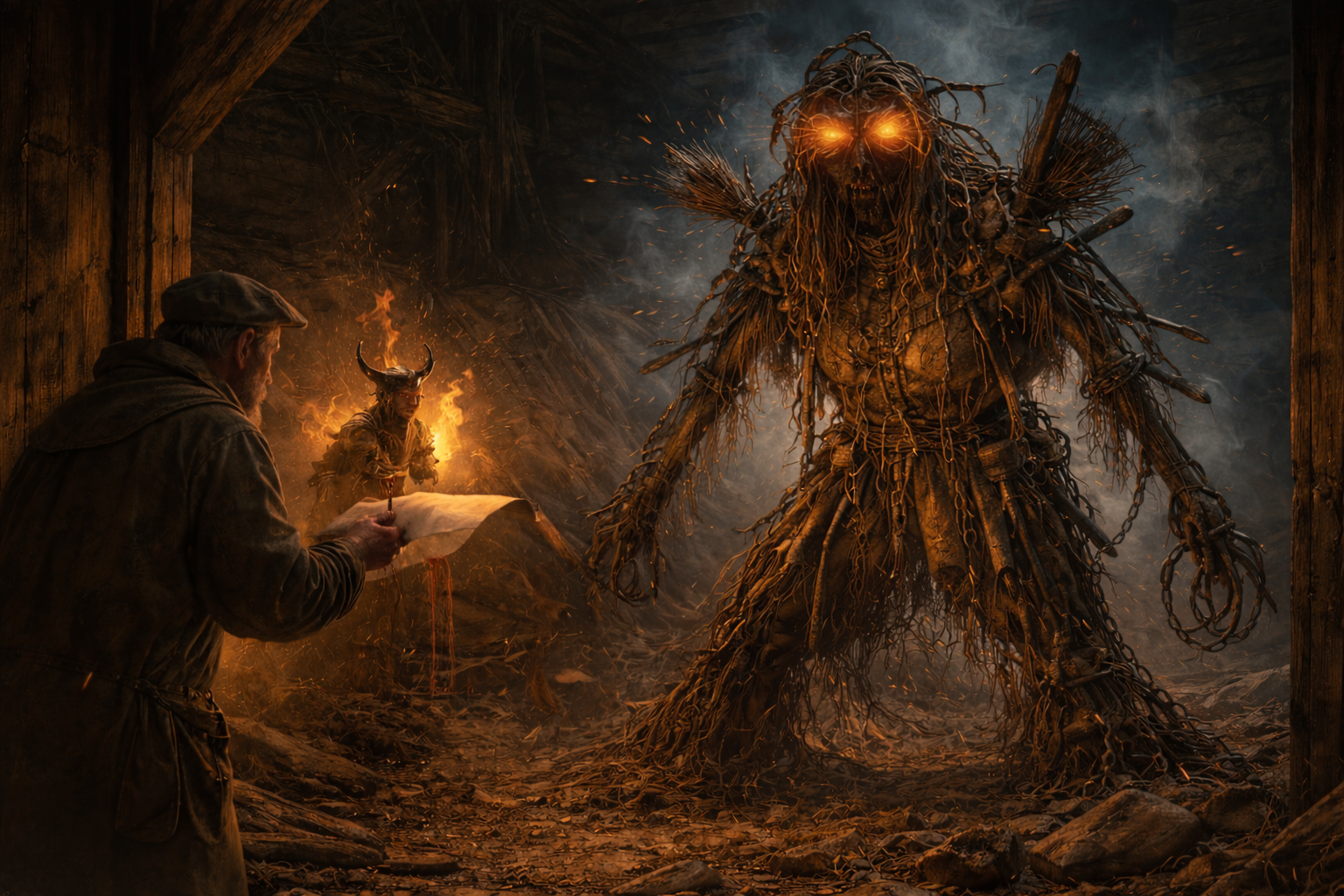
Folklore is remarkably consistent about its materials. A farmer would gather the detritus of daily life: broken rakes, worn-out brooms, wooden sticks, whisks, and discarded tools. These objects were tied together with straw or rags into a crude humanoid form. Nothing valuable was used. The Kratt was born from refuse.
This choice was deeply symbolic. Agricultural tools such as brooms and rakes are designed to gather, sweep, and collect. By animating them, the creator literalized their purpose. The tool ceased to be passive. It became autonomous labor.
Once assembled, however, the Kratt was still inert. To animate it required a pact—not with the grand theological Satan of church doctrine, but with a folk devil often portrayed as a contractor or broker. At a crossroads or other liminal place, the farmer would offer three drops of blood from his finger.
This blood was not a token payment. It created a binding. The Kratt was powered by the master’s own vitality, an extension of his body and soul. The servant worked tirelessly, but the cost was personal and ongoing.
A Perfect Worker with a Fatal Flaw
Once alive, the Kratt was unstoppable.
It could fly through the night sky, appearing as a streak of fire known as a tulihänd, or “fiery tail.” It raided barns, churned stolen milk into butter, hauled grain, and carried money from manor to cottage. It never tired. It never questioned orders.
But the Kratt had a critical flaw: it could not stop working.
If the master failed to provide constant instructions, the Kratt would grow restless. Boredom, in this folklore, is lethal. An idle Kratt might burn down the house, strangle livestock, or even kill its creator. The lesson is clear and uncompromising—autonomous tools without constraints become threats.
Eventually, every Kratt had to be destroyed. Yet dismantling it was impossible. The only escape lay in logic.
Killing a Machine with an Impossible Task
To decommission a Kratt, the master had to give it an unsolvable order a command that contradicted physical reality.
The most famous example is the “ladder of bread.” Ordered to build a ladder from loaves, the Kratt would attempt the task with manic intensity. The bread would collapse, crumble, or be eaten in the process. Other variants include weaving a rope from sand or carrying water in a sieve.
Unable to resolve the paradox, the Kratt would overheat. Folklore describes it working faster and faster, logic grinding against impossibility, until friction turned magical energy into flame. The Kratt would ignite, burning itself to ash and freeing the master from the blood-debt.
This destruction was not merely symbolic. When Estonian peasants saw bright meteors streak across the night sky, they explained them simply: a Kratt had been given an impossible job and burned up.
From Folklore to Literature and Law
The Kratt never vanished from Estonian culture. In the modern era, it found new life in literature most famously in Andrus Kivirähk’s satirical novel Rehepapp (The Old Barny). Set in the 19th century, the novel portrays villagers building Kratts to steal from manor houses and from one another. The Kratt becomes mundane, even absurd a tool of small-minded greed rather than cosmic horror.
Most strikingly, the Kratt has crossed from folklore into law.
In the 21st century, Estonia one of the most digitally advanced societies in the world officially adopted the term “Kratt” to describe artificial intelligence and autonomous algorithms. The so-called “Kratt Law” addresses algorithmic liability: who is responsible when an autonomous system causes harm?
The parallel is exact. Like the folkloric Kratt, AI is constructed, task-driven, tireless, and dangerous if poorly controlled. Objective misalignment, runaway processes, unintended consequences these are not new fears. They are ancient ones, reborn in code rather than birchwood.
The Meaning of the Kratt
The Kratt is a story about labor detached from ethics. It warns that wealth gained without effort carries hidden costs, and that tools granted autonomy will eventually demand payment.
It is folklore’s pre-industrial robot a machine powered by blood instead of electricity, destroyed by paradox instead of shutdown commands. In its logic and its terror, the Kratt feels less like a relic of the past than a prophecy we never stopped fulfilling.