The Sennentuntschi: The Alpine Doll of Retribution
High above the valleys, where the air thins and sound seems to fall away into the stone, there is a kind of silence that presses inward. It is not peaceful. It is watching. The men who know the Alps best those who walk behind cattle bells and sleep under roofs blackened by centuries of smoke say that silence can hollow a person out if they remain too long within it.
Every summer, the Sennen climbed with their herds to the high pastures. Below them were villages, churches, women, and the rules that gave shape to life. Above them were only grass, rock, and months of isolation. The huts were small, the work monotonous, the nights endless. When clouds swallowed the peaks, the world felt unfinished, as though God had abandoned it halfway through creation.
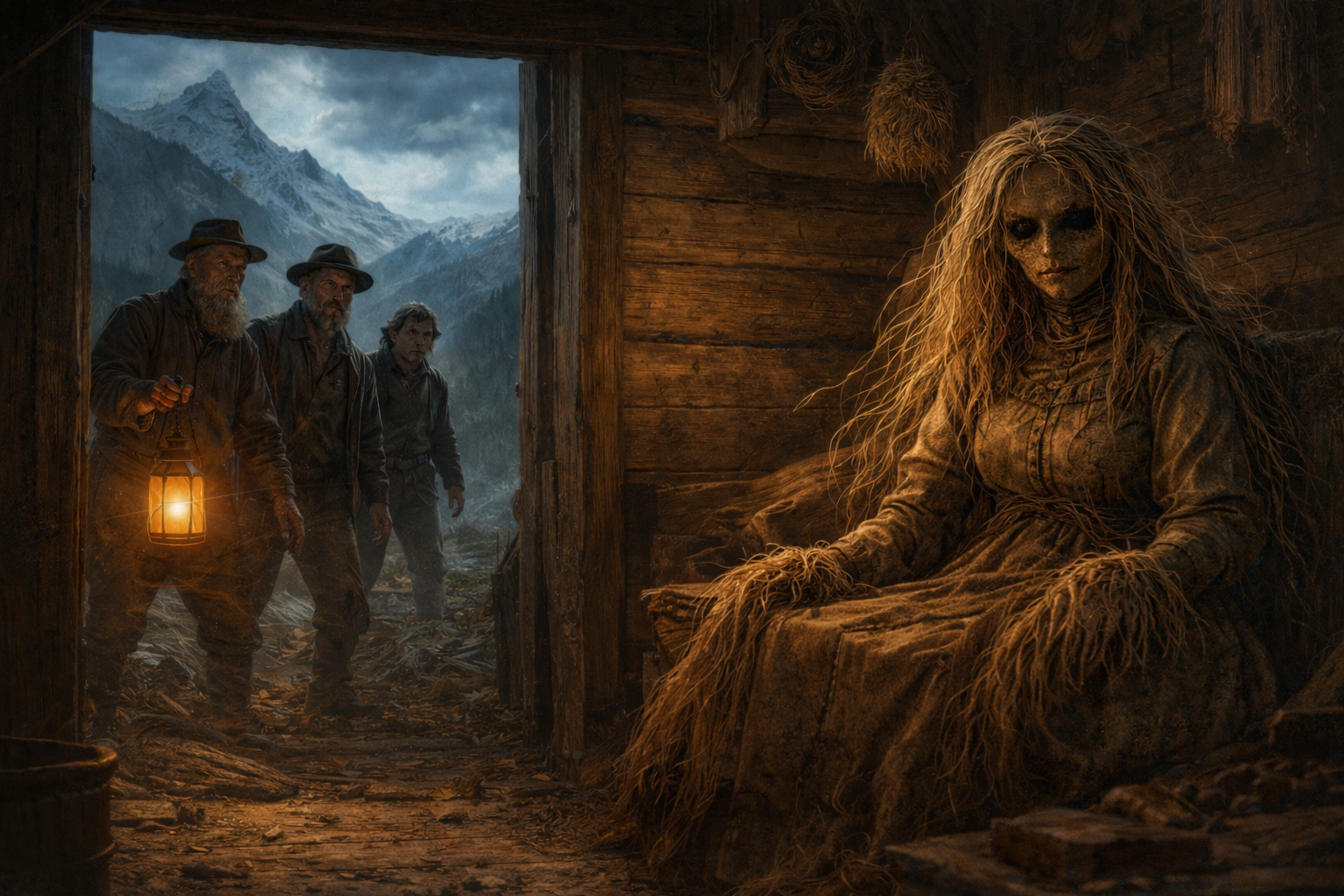
That summer, three herdsmen shared a hut. The oldest had hands like knotted roots and spoke little, carrying tradition in his bones. The middle one worked hardest, rising before dawn and sleeping last. The youngest had barely shed boyhood, his voice still uncertain in the mountain air. At first, they passed the evenings with cards and stories, but repetition grinds even the strongest habits into dust. Laughter thinned. Words ran out.
It began as a joke, the kind born of boredom rather than joy.
From straw left over from bedding, from broom handles and scraps of cloth, they fashioned a figure. Arms tied too long, legs uneven, a head stuffed with wool. Someone gave it a crude face, charcoal smudges for eyes and a mouth twisted into a smile. They sat it upright on a bench and laughed at their own cleverness.
“She’s prettier than any girl down in the valley,” one of them said, and the joke grew legs.
They called her the Sennentuntschi the herdsman’s doll.
At first, she was a prop. They spoke to her as though she could hear, set an empty bowl before her, poured a drop of milk onto the floor in mock ceremony. But something subtle changed. Loneliness has a way of thickening imagination, of turning play into habit and habit into belief. They began to argue over where she should sit, whose turn it was to “feed” her. The laughter grew harsher, edged with something mean.
The young boy watched more than he acted. He laughed when the others laughed, but his hands stayed close to his sides. The doll unsettled him. At night, when the fire burned low, he thought he saw her shape shift in the corner of the room, straw breathing where straw should not breathe.
As weeks passed, the men grew cruel.
What they could not say to women, what they could not do under the eyes of the village, they poured into the doll. They cursed her, struck her, dragged her across the floor. They spoke to her with a contempt sharpened by repression, and in doing so they fed something dark. Thought has weight in the mountains. Words echo longer than they should. The hut remembered everything.
By the time autumn crept down from the peaks, fog trailing behind it like a shroud, the Sennentuntschi no longer felt like a joke. She sat where they left her. She faced the door. No one remembered placing her that way.
On the final night before the descent, the wind pressed hard against the walls. The cattle were restless. Sleep came in fragments. Sometime before dawn, the youngest woke to the sound of straw shifting.
He saw her sit up.
There was no miracle in it, no light, no blessing. The movement was stiff, wrong, as though the world itself objected to what was happening. Her head tilted. Her charcoal mouth split wider than it had been drawn.
She stood.
The boy scrambled back, heart hammering, unable to scream. The other men woke as she crossed the room, her steps soft but deliberate. She placed herself in front of the door. The hut felt suddenly smaller, the air thick and sour.
She did not speak, but judgment does not always require words.
The oldest man reached for her and fell back, sobbing, clutching his hands as though burned. The middle one shouted, fury rising to meet fear, and lunged. She turned toward him then, and the boy saw in her empty eyes everything they had poured into her the loneliness, the violence, the hunger.
She moved aside only once.
The boy ran. He did not remember opening the door, only the shock of cold air and the sound of his own breath tearing from his chest as he fled downhill through fog and rock. He did not look back.
When the villagers climbed to the hut days later, unease walked with them. The cattle were gone. No smoke rose from the chimney. Inside, they found the body of one man, laid out as though carefully prepared. There was no blood left to spill. His skin had been taken.
They found it stretched across the roof, pulled taut and drying in the alpine wind like cured leather.
The doll sat at the table, straw hands folded neatly before her. Or, in other tellings, she had collapsed back into nothing more than rags and sticks, her purpose fulfilled, the spirit that animated her gone as suddenly as it came. The hut, however, never felt empty again.
The story spread as stories do in the mountains, carried from valley to valley, reshaped but never softened. Some whispered that the doll laughed. Others insisted she vanished with the fog. What remained constant was the lesson: the Alps are not beyond morality. Isolation does not absolve cruelty.
Even centuries later, the tale refuses to fade. It disturbs because it strips away the painted innocence of mountain life and exposes what festers beneath enforced silence and denial. The Sennentuntschi is not a monster born of wilderness, but of people who tried to create humanity without responsibility who wanted a body without a will.
In the end, the doll only returned what she was given.
Up high, where the pastures meet the sky, the huts still stand. And when the wind catches the eaves just right, some swear they hear straw shifting inside, waiting.